In the previous post I had shown how I had used some steel drain pipes in a scene. These are commonly used under railroad tracks and roads and come in a range of sizes. The ones in my scene scale to about 18 inch diameter. This post is about how I made them.
Starting out with 1/8 inch diameter Evergreen styrene tube, I use a 6-32 die to turn threads on the outside of the tube. Because the die cuts through the plastic easily I was able to turn the die by hand without the die handle.
To make the ends appear thinner I turn the pointed end of a # 11 hobby knife blade around the inside a few times.
I used Model Master acrylic aluminum to paint these. After painting I noticed that the threads seem too sharp so I sanded them just a bit to make them rounder and then added another coat of paint.
The unpainted part is just a handle and will be cut off before placing them into the scene.
With different sizes of styrene tube and different dies, various sizes of these steel culvert pipes can be made using this technique for use in models scenes.
Wednesday, March 18, 2020
Steel drainage pipes from styrene tube
Thursday, March 12, 2020
Turning a mistake into something interesting
With the recent new addition to the layout I ended up with a spot on the upper line where the existing section met the new section that had a kink in the vertical alignment. I was able to lift and shim the track to get a satisfactory alignment.
Of course this left a funny looking spot and my first thought was to try to build up the scenery around the track to hide the fact that the track was not firmly on the cork road bed. Then I got an idea to create something more interesting. This could have been an area were moisture had been seeping out of the hillside above and the erosion had created a minor washout and sink in the track. I wanted to model an area where the track crews had improved the drainage, shored up the right of way, and straightened out the track.
I made this wood retaining wall from .060 x .060 square styrene rod. The texture was made by dragging a razor saw lengthwise.
The retaining wall assembly was then brush painted with Model Master railroad tie brown.
The finished retaining wall was glued into place with white glue and held with pins while the glue dried.
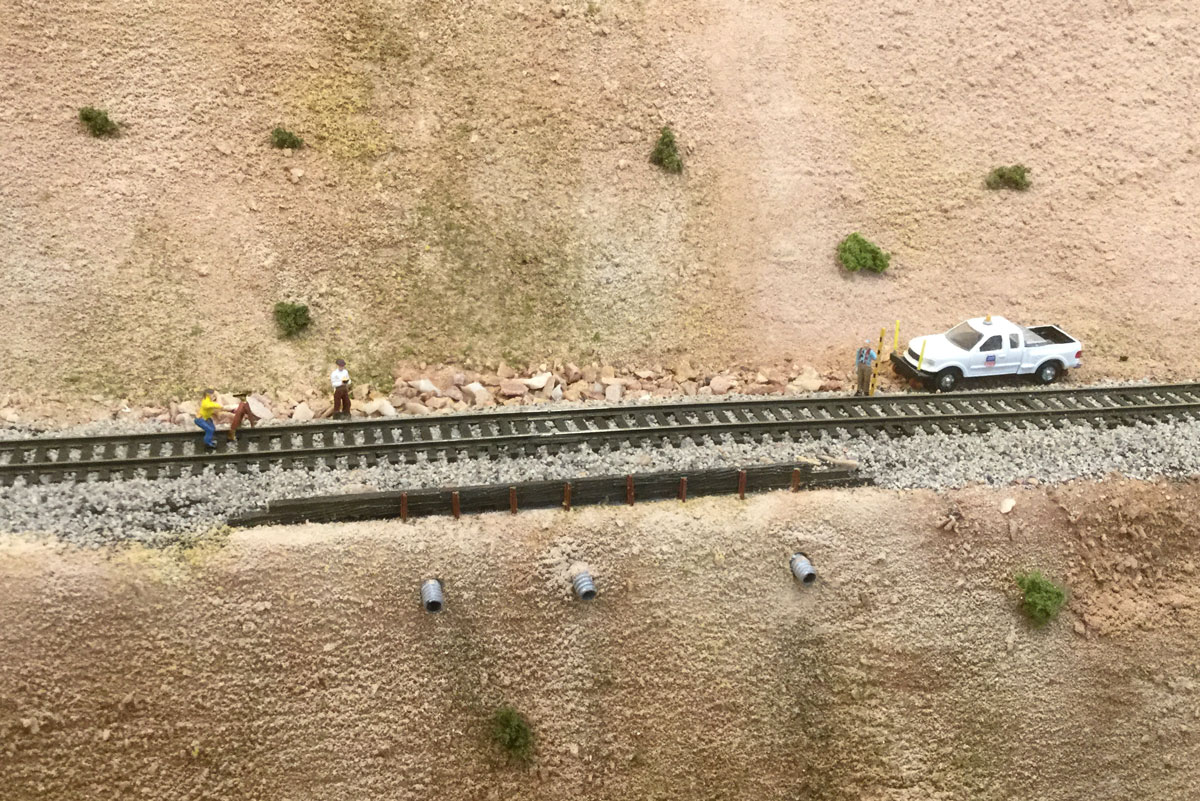
Next I added some short sections of code 40 rail as vertical supports for the retaining wall. Then the low areas were built up with rock material and the track was ballasted. Drain pipes were added below to show how water is being drained from the area prone to washouts.
Here a survey crew is checking on how the track alignment was holding up several months after the washout repairs were made. So far things are things seem to be working out.
Of course this left a funny looking spot and my first thought was to try to build up the scenery around the track to hide the fact that the track was not firmly on the cork road bed. Then I got an idea to create something more interesting. This could have been an area were moisture had been seeping out of the hillside above and the erosion had created a minor washout and sink in the track. I wanted to model an area where the track crews had improved the drainage, shored up the right of way, and straightened out the track.
I made this wood retaining wall from .060 x .060 square styrene rod. The texture was made by dragging a razor saw lengthwise.
The retaining wall assembly was then brush painted with Model Master railroad tie brown.
The finished retaining wall was glued into place with white glue and held with pins while the glue dried.
Next I added some short sections of code 40 rail as vertical supports for the retaining wall. Then the low areas were built up with rock material and the track was ballasted. Drain pipes were added below to show how water is being drained from the area prone to washouts.
Here a survey crew is checking on how the track alignment was holding up several months after the washout repairs were made. So far things are things seem to be working out.
Friday, March 6, 2020
Main line has reopened once again
Since last October when I started the Palisade Canyon extension to the layout there have been two dead end lines with no way to actually run a train all the way through. That all changed a few days ago when things got completed enough to put in a new turn around loop.
This photo shows the newest temporary turn around loop. This sub road bed was constructed from scraps of plywood and supported on the permanent bench work for what will be the next extension.
The PSX-AR module that had been under the old turn around loop was re-mounted under this new one. The DCC bus was extended to it and two feeder pairs from the new loop connected to the output.
This view shows almost all of the new extension of the layout. It's about 6 linear feet going around the corner.
After almost 5 months of construction and not being able to get to any train show layouts I had really missed being able to run my trains properly. Now I am running everything through the new section to test the track work and so far it's all running well.
This photo shows the newest temporary turn around loop. This sub road bed was constructed from scraps of plywood and supported on the permanent bench work for what will be the next extension.
The PSX-AR module that had been under the old turn around loop was re-mounted under this new one. The DCC bus was extended to it and two feeder pairs from the new loop connected to the output.
This view shows almost all of the new extension of the layout. It's about 6 linear feet going around the corner.
After almost 5 months of construction and not being able to get to any train show layouts I had really missed being able to run my trains properly. Now I am running everything through the new section to test the track work and so far it's all running well.
Tuesday, March 3, 2020
Finishing the skewed bridge
The bridge got a set of 3D printed bridge shoes from Shapeways which established what the exact height of the abutments needed to be. The abutments were made from wood and painted with Model Master concrete and weathered with acrylic wash and then powders. This one also got some graffiti on it.
The track for this bridge was made up of section of Micro Engineering standard code 55 track with some of the ties removed and replaced with the bridge ties that came with the Central Valley bridge kit.
My Floquil old silver had run out but Model Masters aluminum was a perfect match for the second paint coat. The bridge then got some weathering and the track assembly was attached to the bridge with E6000 adhesive.
The bridge was set it place with E6000 adhesive on the bottoms of the bridge shoes to secure it. The tracks were connected to the adjoining sections and secured to the cork road bed with while glue. I will wait on the ballasting the track until I've done a good bit of testing with a variety of trains.
The track for this bridge was made up of section of Micro Engineering standard code 55 track with some of the ties removed and replaced with the bridge ties that came with the Central Valley bridge kit.
My Floquil old silver had run out but Model Masters aluminum was a perfect match for the second paint coat. The bridge then got some weathering and the track assembly was attached to the bridge with E6000 adhesive.
The bridge was set it place with E6000 adhesive on the bottoms of the bridge shoes to secure it. The tracks were connected to the adjoining sections and secured to the cork road bed with while glue. I will wait on the ballasting the track until I've done a good bit of testing with a variety of trains.
Friday, February 28, 2020
Building a curved steel trestle - Part 2
After starting the curved steel trestle back in October it has taken quite awhile for me to get back to finishing it. Now that the lower track has been completed and the scenery around the back of the corner is almost complete, this bridge can be finished.
The bridge pieces were assembled and then painted with the air brush. I had been using Floquil old silver for some of my bridges but finally had run out and of course the Floquil line is no longer available. Turns out that Model Master aluminum is a very close match so that's what I used this time.
I had used Micro Engineering bridge track for the first time on the 200 ft BLMA through truss bridge. Because that bridge was straight and access to the track would be restricted I chose to fully assemble and paint the track with it's guard rails and guard timbers before installing it on the bridge. This time I did make up a section of bridge track with both ends having standard ties but am going to wait until after it is installed to add the guard rails and paint.
The bridge was weathered and installed on the layout. Then the track was attached to the bridge with E6000 adhesive and held with small clamps while the adhesive set. The position of the track on both ends of the bridge was held in place with map pins.
The guard timbers were attached to the track the same way they were on the 200 ft BLMA bridge but this time cut into shorter lengths to match the curvature of the track.
The bridge pieces were assembled and then painted with the air brush. I had been using Floquil old silver for some of my bridges but finally had run out and of course the Floquil line is no longer available. Turns out that Model Master aluminum is a very close match so that's what I used this time.
I had used Micro Engineering bridge track for the first time on the 200 ft BLMA through truss bridge. Because that bridge was straight and access to the track would be restricted I chose to fully assemble and paint the track with it's guard rails and guard timbers before installing it on the bridge. This time I did make up a section of bridge track with both ends having standard ties but am going to wait until after it is installed to add the guard rails and paint.
The bridge was weathered and installed on the layout. Then the track was attached to the bridge with E6000 adhesive and held with small clamps while the adhesive set. The position of the track on both ends of the bridge was held in place with map pins.
The guard timbers were attached to the track the same way they were on the 200 ft BLMA bridge but this time cut into shorter lengths to match the curvature of the track.
Friday, February 21, 2020
Installing the 200 ft BLMA bridge
These bridges come with some nice stainless steel walkways and railings. The hand rails are painted an oxide red color that has a semi-gloss finish.
For me it did not seem right to have a bright or glossy finish on a bridge that could be 80 years old in my modeled era. So I did the same thing that I had done on the 150 ft bridge before installing it about a year ago on the Harney layout section. I removed the walkways and air brush them flat oxide red.
The Micro Engineering track assembly completed in the LAST POST was attached to the bridge structure by placing a bit of clear E6000 adhesive on the tops of the bottom frame of the bridge and then holding with clamps as shown in this photo. It was important to keep the track centered between the walkways.
I tested several of my largest freight cars for clearance rolling them through the bridge on the work bench before actually installing the bridge on the layout.
On the Harney layout section I had weathered the bridge with black acrylic wash before installing it but this time found out my weathering wash had dried out so I installed this bridge first and will weather it in place. The track was then glued to the road bed and connected.
For me it did not seem right to have a bright or glossy finish on a bridge that could be 80 years old in my modeled era. So I did the same thing that I had done on the 150 ft bridge before installing it about a year ago on the Harney layout section. I removed the walkways and air brush them flat oxide red.
The Micro Engineering track assembly completed in the LAST POST was attached to the bridge structure by placing a bit of clear E6000 adhesive on the tops of the bottom frame of the bridge and then holding with clamps as shown in this photo. It was important to keep the track centered between the walkways.
I tested several of my largest freight cars for clearance rolling them through the bridge on the work bench before actually installing the bridge on the layout.
On the Harney layout section I had weathered the bridge with black acrylic wash before installing it but this time found out my weathering wash had dried out so I installed this bridge first and will weather it in place. The track was then glued to the road bed and connected.
Saturday, February 15, 2020
Working with Micro Engineering bridge track
As I prepare to install the 200 ft BLMA through truss bridge I needed to first prepare the track that will be inside the bridge.
On the 150 ft BLMA bridge I had used a Central Valley Model Works bridge tie set installing it in the center of a section of Micro Engineering code 55 track after some standard ties were removed. That project was covered in THIS POST.
For this bridge I did just the opposite, removing some of the ties from each end of a section of bridge track and replacing them with ties removed from the standard track in the last project. The ends of the rails must be nice and smooth to for the ties to slip off and on.
I laid the track out nice and straight on a soft pine plank and pinned it to hold it straight. I also added a short section of standard track onto one end. The bridge kit set comes with a pair of code 40 rails to make the guard rails. I attached these with E6000 adhesive spread on the bottom of the rails.
Also included with a section of Micro Engineering bridge track are several sets like this one that have guard timber sections and parts for a barrel platform. I only used the guard timbers attaching them near the ends of the ties with ACC adhesive.
The track assembly was air brushed with Model Master rail tie brown with the ends masked so they can be soldered to adjoining sections of track. The outsides of the main rails and insides of the guard rails were then painted with a rail brown paint pen. The tops of the main rails were cleaned off with a razor blade. This assembly is now ready for the bridge.
On the 150 ft BLMA bridge I had used a Central Valley Model Works bridge tie set installing it in the center of a section of Micro Engineering code 55 track after some standard ties were removed. That project was covered in THIS POST.
For this bridge I did just the opposite, removing some of the ties from each end of a section of bridge track and replacing them with ties removed from the standard track in the last project. The ends of the rails must be nice and smooth to for the ties to slip off and on.
I laid the track out nice and straight on a soft pine plank and pinned it to hold it straight. I also added a short section of standard track onto one end. The bridge kit set comes with a pair of code 40 rails to make the guard rails. I attached these with E6000 adhesive spread on the bottom of the rails.
Also included with a section of Micro Engineering bridge track are several sets like this one that have guard timber sections and parts for a barrel platform. I only used the guard timbers attaching them near the ends of the ties with ACC adhesive.
The track assembly was air brushed with Model Master rail tie brown with the ends masked so they can be soldered to adjoining sections of track. The outsides of the main rails and insides of the guard rails were then painted with a rail brown paint pen. The tops of the main rails were cleaned off with a razor blade. This assembly is now ready for the bridge.
Sunday, February 9, 2020
Finishing the scenery window box
The rock casting work and most of the scenery work was done with the box out of the window and sitting on saw horses. Being able to tilt the box at various angles made adding the scenery material easier.
While the scenery window box was being worked on at the saw horses I was also working on the scenery around the area of the window. This photo shows how the area looked after both were dry and the box was installed.
To better blend the scenery another application of scenery materials was done on while the box was in place. I have temporarily set the bridge and tracks in place to show how this scene will look with a train going through it.
This is what it looks like from outside the window. The back of the scenery box was painted with the white house trim. I may also paint the parts of the main bench work visible in the window the same color.
While the scenery window box was being worked on at the saw horses I was also working on the scenery around the area of the window. This photo shows how the area looked after both were dry and the box was installed.
To better blend the scenery another application of scenery materials was done on while the box was in place. I have temporarily set the bridge and tracks in place to show how this scene will look with a train going through it.
This is what it looks like from outside the window. The back of the scenery box was painted with the white house trim. I may also paint the parts of the main bench work visible in the window the same color.
Sunday, February 2, 2020
Progress on the scenery window box
Work continues on the scenery window box in the Palisade Canyon section of the layout. To round out those sharp corners in the box I installed some plastic paneling attaching it with Liquid Nails adhesive.
The hillside was built up using pieces of insulation board to create a continuation of the canyon wall. Liquid Nails adhesive was also used to secure the insulation board.
Then the insulation board was covered with plaster cloth. The rock formations along the top are now being added and the plastic panel sky board got it first coat of paint.
The hillside was built up using pieces of insulation board to create a continuation of the canyon wall. Liquid Nails adhesive was also used to secure the insulation board.
Then the insulation board was covered with plaster cloth. The rock formations along the top are now being added and the plastic panel sky board got it first coat of paint.
Subscribe to:
Comments (Atom)