Showing posts with label bridge. Show all posts

Saturday, October 22, 2022

The Carlin foot bridge - part 2

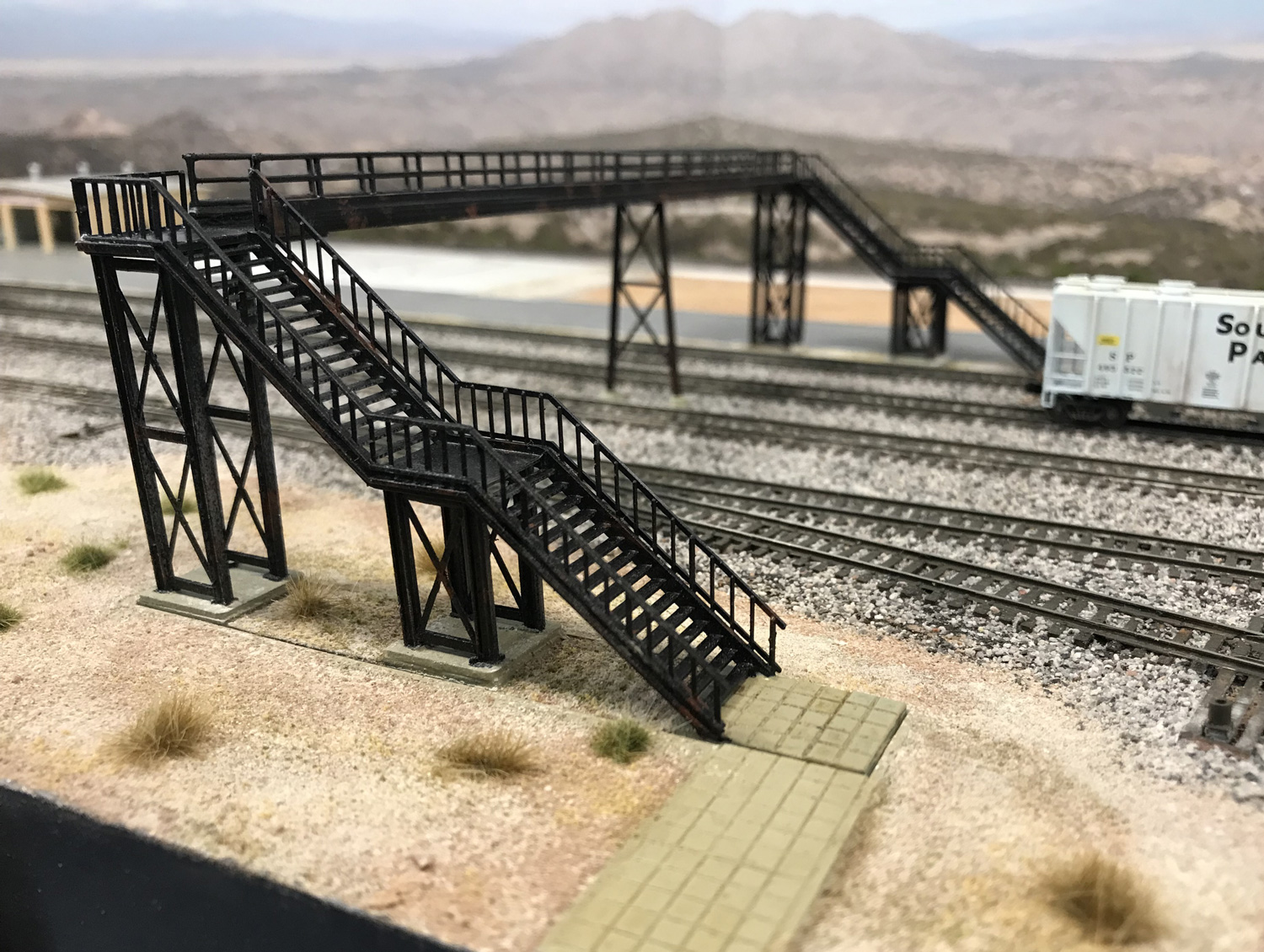
Way back in May I had started a model of the foot bridge over Carlin Yard.  The link to that post is HERE.  I finally got back to this project recently.  I ended up using Plastruct railings for the bridge and a left over support from the Walthers Glacier Gravel kit was used as mid span support.  The prototype has more than one so I will want to add another whenever can I find another similar support.


The entire bridge was airbrushed a flat black color and a little dry brush weathering was applied.  Side walks were added to the bottoms of each stairway.


The areas of the stairway bases that were not painted concrete color got some scenery applied to match the scenery in the surrounding area.


Monday, October 10, 2022

Fall 2022 layout update

This month marks the 8th anniversary of the layout.  A lot has been completed over that time but still plenty more to do.  Over this past year or so most of the attention has been on the 11+ feet of Carlin over two bench work sections.  I have also been operating the layout and developing an operating scheme using car cards and waybills.  Recently I have added car card holders to all of the spurs as well as for the arrival / departure track in Carlin yard.


The scenery is continuing with the back edge of the Carlin section has being finished and blended in with the back drop shown in the photo below.  The area around the river between Carlin and the Palisade tunnels is in progress now.

With all of the track work in Carlin now done, next will come finishing industries, structures, and adding details.   Recently I added some 3D printed wheel stops to the ends of all of the spur tracks in Carlin.


Sunday, May 22, 2022

The Carlin foot bridge - part 1

In Carlin there is a foot bridge over the rail yard and this is something I wanted to represent on the layout.  Here is a Googlemaps photo of the prototype.  There appears to have originally been more than the 4 tracks that pass under this bridge today but some have been removed.  Because of compression of the scene my bridge will just span over the 4 tracks.


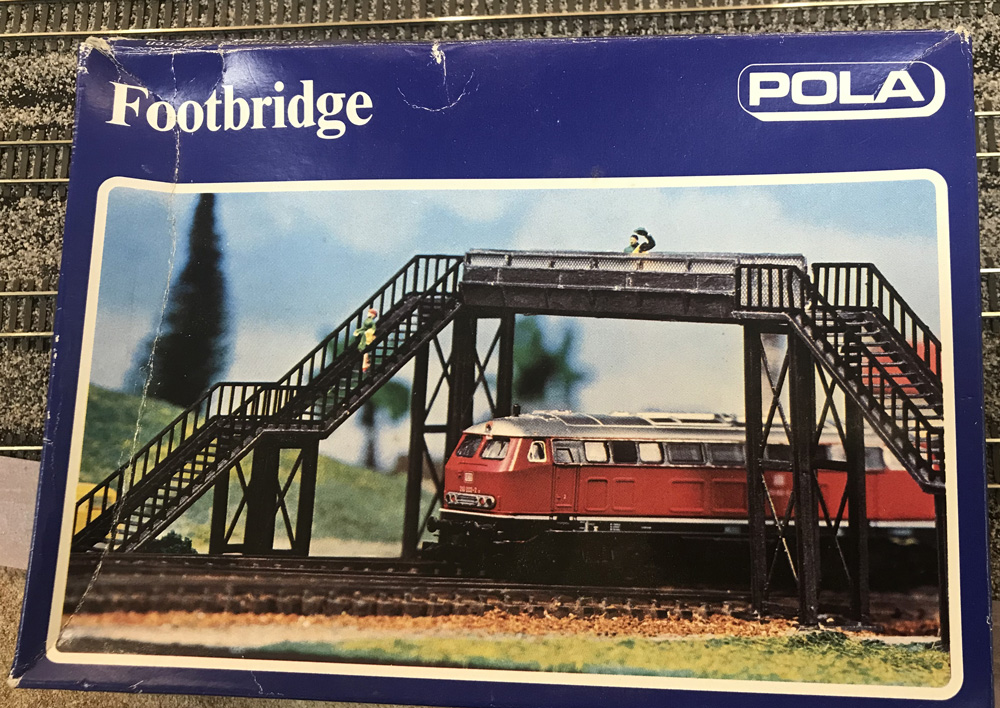
My bridge is going to end up being a bit different due to the need to compress things.  The prototype has ramped ends but mine is going to be stairs.  Also it looks as if the railing on the prototype are made of wood and my model is going to be all steel.  The starting point is a Pola kit that I picked up last year at a local club's open house.  This bridge only spans 1 or 2 tracks but that's OK as I can use the stairs and scratch built the rest.


This is how the foot bridge looks right now with the scratch built deck.  Not so noticeable in this photo is a support tower near the middle that was left over from the Walthers glacier gravel kit.  I have a few ideas for railings on the deck and will hopefully find something on my next hobby shop visit.


These stair towers were not quite tall enough for modern American rolling stock to clear underneath so they were placed on a base that gives them some extra height.  I then tested all my tallest rolling stock for clearance and they all were OK.  I also want this model to be removable from the layout so I made my normal pits for the stair tower bases and built up the scenery around them.  The drilled a hole and glued in a couple of the small magnets I keep for this purpose.  A thin piece of sheet steel was glued to the top of the base between the pair of towers on each assembly to interface with the magnets.  This will be covered with scenery.  The bridge deck is a separate assembly that will connect to the towers with clear styrene strips on each end that side into a space between the bottom of the tower deck and a horizontal beam. 

After the railings are finished, this bridge will be painted black with perhaps some other details added and some weathering.

Sunday, June 6, 2021

One more bridge

There are already 6 through truss bridges on the layout but I will be adding one more in the next expansion of the layout.  This one will represent the bridge that was on the Southern Pacific line on the east side of the Palisade tunnels which served the line for more than 100 years but was demolished by a derailment in 2008.


For this bridge I choose to use the brass kit from Micron Arts.  I have only done small brass kits up to the point and this by far will be the most complex one I tried.   I've had this kit stashed away for some time and honestly have been a little intimidated by it's complexity.


The most difficult part seemed to be the first step of the kit assembly.  I found that adding the webbing to the vertical uprights to be quite challenging.  After trying both soldering a gluing these and destroying some of the webbing parts I gave up and decided to leave the webbing out.  I cleaned up the solid parts of the vertical uprights and pressed on and then things went together more smoothly.


Taking my time in building this kit it still went surprising fast.  I was soldering most of the parts and did not have to wait for any glue to dry.  The finished assembly was quite strong and sat squarely on it bridge shoes.  In the photo below it is placed in about the location where it will eventually be installed.

Somewhere I read that brass models should be soaked / washed in vinegar before painting to slightly etch the surface so the paint will adhere better.  I let this soak for several hours and also used an old toothbrush to wash away any solder flux that might be left in the corners.  After the vinegar soak the model was rinsed and left to dry overnight.


Lately I have been trying out some paints from Mission Models and like them.  Using my airbrush I first applied two coats of their gray primer.  The coverage was fine but it took 2 coats to get all the different angles of all the parts.


After letting the primer dry overnight, I gave the model 2 coats of what Mission Models calls tire black which is a flat black.


Now being finished except for some weathering, this will be put away until construction starts on the next expansion.  I don't expect that to happen until winter at the soonest.  The kit came with a section of code 55 bridge track the same length as the bridge.  I won't use this as I like to use a longer section and replace the bridge ties on both ends with standard ties so the joints are well clear of the bridge ends.

Tuesday, January 12, 2021

Electrical considerations for a lift bridge

When adding a removable section of tracks to span a gap in the layout such as the entry door to the layout room some thought has to be given to a few problems. 

How will any needed wiring pass through the bridge ?

My train room was built in the back half of a garage that is about 70 years old.  The concrete floor was in poor enough condition that I elected to build a raised floor which ended up being about 9 inches above the concrete garage floor.   Anticipating that layout wiring may need to span across the doorway I included a 1 inch diameter electrical conduit that connects each side of the doorway.  This conduit travels down the wall on each side and under the ramp that leads from the garage floor at the door up to the raised floor if the layout room

A pull line had been left in this conduit when it was installed so it was easy to pull in an 8 conductor, 18 gauge cable at this point in the layouts development.  Each end of the cable was terminated on a terminal strip.  A new pull line was also pulled in at the same time so future cables can be installed the same way.


How are the tracks on the bridge itself connected to track power ?

In this case there are 2 tracks that go across this bridge with each being connected to a different DCC Specialties PSX-1 DCC circuit breaker.  While there are special door hinges used for electrical door locks that could be used, these are quite expensive so I am just using 4 flexible wires.  These wires are 18 gauge but are made up of many smaller strands and that is what makes them more flexible.  The ends are connected to terminal strips so can easily be replaced if movement eventually causes any of them to break.  


What prevents a train from approaching the bridge when the bridge is open ?

At the end of the bridge that does not have the hinge,  there is a magnetic switch within the frame that the bridge fits into and it's activating magnet that is within the end of the bridge itself.  The bridge has to be fully closed for the switch to activate.   


The magnetic switch controls this group of 5 single pole relays.  4 of the relays control track power, 1 for each rail of 2 tracks.  When the track is installed, it will have an additional isolated gap a few feet from either side of the bridge.   This will stop a train from approaching the bridge when the gate is up.  The 5th relay will be to control a warning light outside the door indicating that the gate is lowered.


  

Wednesday, December 23, 2020

The crooked path across the bridge

Back in June I posted about the lift bridge I had constructed across the entry into the train room, that post can be seen HERE.  After six months and changing seasons it has remained quite stable.  With this current layout expansion the bridge will be needed so now to put some track on it.   The idea of my bridge is to use tunnel portals and hillsides to hide the bridge being in the scene.  

The actual Palisade tunnels that this part of the layout represents on are on a straight alignment but I am going to take some liberties with the track alignments through these tunnels to make my track plan work.   The tunnel portals on the right or west side are angled to allow for a larger radius curve around the corner.   


At the points where the tracks meet at the gaps I am using copper clad PC board as these will hold the track very stable.  I was able to buy the material on ebay in a 2" x 6" size and then cut it into 1" x 2" sizes.   These were then cut at the angle that the track will cross the gap.  Each of the 4 track / gap angles are different.  Holes were drilled on both sides for track nails and a groove was cut through the copper cladding to isolate the rails.


On the lift bridge we built many years ago at the Ntrak club, we used Atlas code 80 re-railer tracks at the gaps.  The idea was that if a set of wheels gets derailed at the joint it will get re-railed right away.  This has worked out well so I wanted to try the same idea on my layout's lift bridge.  A friend had recently given me some Atlas code 55 re-railer tracks and the rails were a perfect match for the Mico Engineering track I am using.   Traffic will move mostly in one direction on each track so the re-railers are placed the side after the train crosses the gap.   Another lesson learned from the Ntrak bridge experience was to round the tops of the rail end a bit.  This helps with smooth running but also with a shirtsleeve being snaged when someone goes through and pulling up the track.


The gaps were done in pairs on the work bench with the second one being done with a tracksetta tool in place to hold the alignment and the track gauge was carefully checked with both an NMRA track gauge and a caliper.


So at this point the   track is in place and everything seems to roll smoothly over the joints with no derailments.  After the holidays I will post about the electrical aspects of the bridge.


Thursday, November 26, 2020

Building a curved concrete bridge

In the next expansion of the layout I will need a bridge where the WP line again crosses the Humboldt River.  The bridge that is actually in that location on the prototype is a 4 section through truss bridge.  My bridge in going to have to be part of a curved section of track so I am going to use a ballasted deck, segmented concrete bridge.  I already have a straight version of this type of bridge that I installed on the Golconda section in February of 2017 and is featured in THIS POST.   For that bridge I had a couple of good prototype photos I was following.  This bridge is going to be more freelanced.  I had considered the BLMA kit which is similar to what I wanted but it was too short for my application so I decided to scratch build this one.

I started by making several bents using some of the poles from Rix Products highway bridge kits.  These are 1/8 inch in diameter so I am only using 3 per bent.  The horizontal beam is cut of pine strip with holes drilled into it for the poles so they are quite sturdy.


The curve is going to be 18 inch radius so using an 18 inch radius Tracksetta tool as a guide I marked out a curved section on a large sheet of .030 styrene sheet.  Then I cut the curve out with a pair of scissors.


.030 thick styrene was cut into five 20 x 17 n scale foot sections and glued onto the curved strip.  The outer edge has small gaps between the sections.  The excess of the original curved sheet of styrene was cut off at each end.   Then .060 x .060 L channel strip was glued along both edges to covers the gaps on the outer edge between the two sheets of .030 styrene. 


The longitudinal beams were made from 1/8 inch Plastruct square tube stock cut into lengths that matched that section along the edges.  To give the bridge deck some stiffness, short lengths of .040 music wire that had a slight bend were glued into the holes of the tube.


On the straight version of this type of bridge I had used 1/8 inch thick acrylic to make the bridge deck stiff but not being able to cut a curve in the acrylic I used 1/8 inch hard board.  Between the music wire joints between the beam sections and the hard board the bridge deck got quite stiff.


.040 x .060 styrene strip was added along the top near the edges of the deck to retain track ballast.  Bridge abutments of the correct height to match the adjoining sub roadbed plus the thickness of the cork were made from 1/4" plywood.   All the pieces were painted with Model Master aged concrete acrylic paint.


The bottoms of the poles were cut and angled to sit on top of 1/8" thick footings on the bottom.  The bridge is shown here set temporarily in place after all the parts were glued together and receiving some weathering.  Once more of the surrounding terrain is built up and the river get at least a basic finish then it can be permanently glued in.


Sunday, August 30, 2020

Freelanced steel viaduct - Part 2

This is the conclusion of a two part post on the building and installation of an over 300 foot long steel viaduct made from Micro Engineering bridge parts.  These were some the things I added to complete the steel viaduct and the surrounding area.

The code 40 rail that comes with the section of Micro Engineering flex track was used to make guard rails over the viaduct.  These were glued into place with ACC (super glue) being aligned by the small bumps that are on the ties for this purpose.  The guard rails were held in place with clamps and pins until the ACC set.
The track was hand painted with Testors rail brown acrylic paint.  The section of standard track between the viaduct and the skewed through truss bridge got ballasted with Arizona Rock and Minerals ballast.
The bridge and concrete piers got some weathering from a combination of washes and weathering powders.  I added some scribble from a dry transfer set to the bridge above one of the piers and am considering some graffiti in a few other areas but will need to find some very small graffiti decals.


Even desert areas like central Nevada have brush and shrubs.  I use a combination of Woodland Scenics clump foliage and Scenic Express prairie grass tufts attached with a dot of E6000 adhesive on the end of a bamboo skewer.
Adding all those shrubs and prairie grass tufts may seem like a tedious task but it's actually quite enjoyable while running a train around the layout and listening to a ball game or music on the radio.
An area like this on a layout lends itself to many possible mini scenes.  Fishermen, boaters, hobos, bridge painters, and more are all things that would work here.  For now I have my canoes and some hikers admiring the bridge.

Tuesday, August 25, 2020

Freelanced steel viaduct - Part 1

I have always admired the tall steel viaducts and wanted to model one on a layout.  I don't know of one being anywhere along the line I am modeling but decided to have one anyway.   This bridge will replace a temporary "track on a stick" type bridge that I put in last March.

As there is no prototype to try to model this from it is of my own design using Micro Engineer parts.  After a lot of trial a fitting this is what I came up with.
Turns out that this viaduct did not need to be very tall so I only used the upper section of the towers and even had to carve out the area below to make those fit.
The land contours under the viaduct had to be redone after all the concrete footings and bridge piers were set in the correct places.  Those were all made from wood with joints carved into them.
Once I was satisfied with the shape of the land some basic scenery was added then the bridge was installed and the Micro Engineering bridge track with a couple of inches on each end having the bridge ties replaced with standard ties.   This track assembly was attached with E6000 adhesive.

Here is an end view looking down the line.  The guard timers have been added to the bridge ties.  Next will be adding the code 40 guard rails, ballasting the track at each end, and adding some shrubs and other details in the area under and around the bridge.

Tuesday, June 9, 2020

Building an entry lift bridge

Over the past week I have been designing and building a lift bridge to carry the layout past the entry door way.

It has always been planned that there would be a lift bridge of some sort here and when I built the room in 2013 I added short sections of half walls on either side of the door to give the bridge something solid to attach to.

There will be tunnel portals on the layout at each end of this bridge so this bridge will actually be a pair of tunnels on the layout.
Here is the left bridge in the up position.  Anything that will go through the doorway such as modules will also pass by the gate.

When the tracks are installed there will be a short feeder cable on the hinge side to power those tracks.


The deck of the bridge is 1/2 inch plywood with 3/4 inch bracing on the bottom at each end.  This gives the hinge screws thicker material to go into.  The sides have 3/4 inch thick rails on the top side of the deck.

Both ends of the gate rest on 3/4 inch thick rails that are attached to the wall structures.   The entire bridge and the supporting structures were sealed with a primer then the outside parts were given two coats of the gray enamel that I use for my fascias.

So when the next layout expansion comes, the gate will be ready.

Tuesday, March 3, 2020

Finishing the skewed bridge

The bridge got a set of 3D printed bridge shoes from Shapeways which established what the exact height of the abutments needed to be.  The abutments were made from wood and painted with Model Master concrete and weathered with acrylic wash and then powders.  This one also got some graffiti on it.
The track for this bridge was made up of section of Micro Engineering standard code 55 track with some of the ties removed and replaced with the bridge ties that came with the Central Valley bridge kit.
My Floquil old silver had run out but Model Masters aluminum was a perfect match for the second paint coat.   The bridge then got some weathering and the track assembly was attached to the bridge with E6000 adhesive.
The bridge was set it place with E6000 adhesive on the bottoms of the bridge shoes to secure it.  The tracks were connected to the adjoining sections and secured to the cork road bed with while glue.  I will wait on the ballasting the track until I've done a good bit of testing with a variety of trains.