Showing posts with label Signaling. Show all posts

Saturday, July 19, 2025

Summer 2025 Layout update

Here's what I've been up to for the past few months that has not been other posts.  During our road trip in May I re-visited the old Santa Fe depot in Needles, California.  As a kid in the mid 1960's I had ridden both the Super Chief and El Capitan several times between the Needles station and Los Angeles Union Station.  This visit rekindled an interest I have add for some time to acquire a model of one of these trains so when we got home, I bid on a set and won. I already had an ABA set of F7's and am working on getting another B unit.


One of the reasons I decided on the El Capitan because I had always liked this transition car.  I had not realized it before, but the step down in actually in the car behind this one.  The flaring was just to streamline the look.


In June the first signal detection circuit I had installed over 5 years ago stopped working.  Both the SP and WP loops in the lower helix were stuck on red.  The problem turned out to be the pair of NCE detectors I was using.  It seemed odd that both would fail at the same time but they got replaced with a new Azatrax dual detector circuit.  As the current limiting resistors for the signals were part of the relay board that I had made for this circuit, I left that in place having the output relays from the Azatrax unit trigger it.


And away from the layout I spent a Sunday in mid-July at the annual ETE Eurowest meet at the Hiller Aviation Museum in San Carlos, helping a friend operate his Swiss narrow-gauge layout and then packing it up at the end of the event.  This year I ran some different sections of the layout than last year.  This is one of my favorite scenes on this layout. 


Thursday, November 21, 2024

Expanding the signaling, again.

Over the past few weeks I have been working on the signaling on the layout.  First to correct some problems I've had in one of the signal blocks, and then to expand the signaling to the upper helix. The signaling on this layout is just red / green aspects with the actual signals being something I have scratch built myself.  Below are links to some of the earlier posts I have made on the signaling.

July 2021 - Expanding the signaling

July 2020 - My home made searchlight signals

May 2020 - First working signals on the layout

So the first step was to correct a problem I have been having with sensitivity on the Southern Pacific line in the 3rd signal block which includes the Carlin yard.  The NCE detectors I have been using don't have any sensitivity adjustment so I picked up a circuit from Azatrax that does have a sensitivity adjustment to see if that would make a difference.  After installing it, I was able to adjust it to get the results I wanted.  A nice thing about this Azatrax circuit was that the double pole relays were included on the board so I did not have to make up a relay board like I have been doing for the NCE sensors.


The sensors and relay board that had been removed from the 3rd signal block location was installed to provide detection for the upper helix which has become the 4th signal block.  They works fine there, I think because the track arrangement is simpler.

At the top of the upper helix the occupancy for each track is indicated with bi-color LED's that were added to the upper return loop control panel.

At the bottom of the upper helix near the east end of the Carlin yard, a pair of signals indicate the occupancy within the helix.


At the west end of the Carlin yard where the crossover leads to the WP track, another signal is connected to the WP signal block.  In the future I would like to have the signal only be green if the block is clear and the turnout is aligned for the crossover.


Tuesday, August 2, 2022

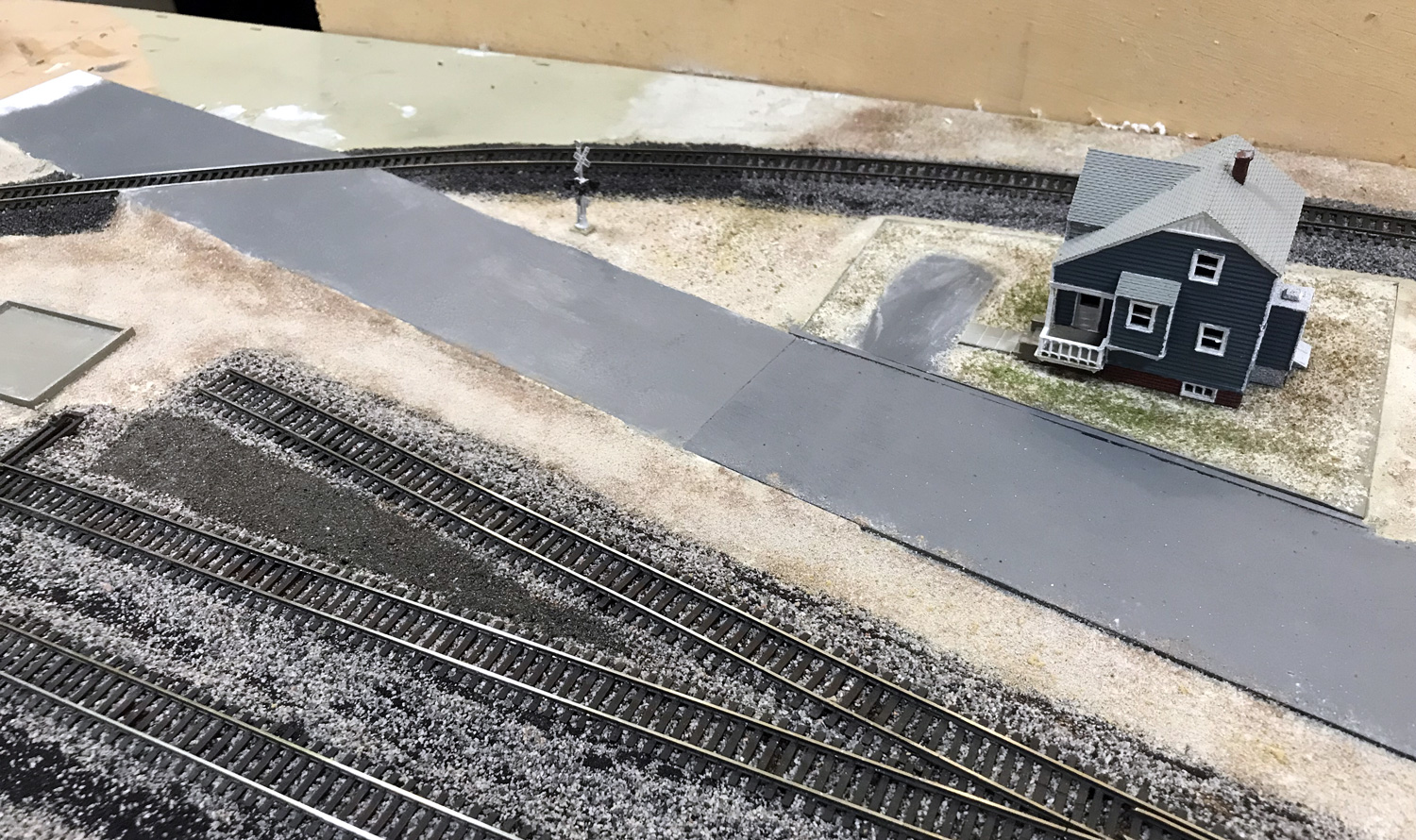
Grade crossing in Carlin

In the real Carlin, there are a pair of multi track grade crossings, one at 4th street and another at 10th street.  I wanted to keep my small modeled yard clear of any grade crossings but did find a spot where Main street crosses the Western Pacific line to include one of these interesting features.

The grade crossing that I had set up in Battle Mountain a few years ago was no longer working correctly but the signals themselves were OK so I transplanted them to Carlin.  These NJ International signals have lights on both sides and as this crossing would be visible from both sides I wanted to use them here.  When I rebuild the crossing at Battle Mountain I plan to scratch build some signals that will only have lights on one side as they can only be seen from the front.   In Carlin I am using the crossing controller from Azatrax with the IR transmitter and receiver being in between the ties using the reflective mode.  For the sound I am using the ITT Products grade crossing module.  These circuits are mounted under the bench work.


The instructions that same with the sound module recommends a speaker with an 8 ohm input impedance.  For about $5.00 each on Amazon I found some 2 inch, 8 ohm speakers.  I am impressed with the sound quality from these.


These speakers are also small enough to hide in a small structure.  This one will be in a 3D printed house that is nearby the crossing.  I still need to get the part between the rails done and also some markings on the road.


When I set up this signal, this section of bench work was still on the saw horses and everything worked great.  After installing the section into the layout the sensors started to get false triggers.  What was happening was that the invisible IR beam was reflecting off the bottom of the cabinets which are 17 inches above the track.  I taped up some of the same black craft foam that I used on the roads and that seems to have solved the problem.  So I may need to either attached these foam sheets more permanently or paint the bottoms of the cabinets a flat black in this area.

Friday, July 23, 2021

Expanding the signaling

Over the summer I have been adding several new searchlight signals to the layout.  Track gaps were cut on the Western Pacific line near the Humboldt River rapids and on the Southern Pacific line between the skewed bridge and the viaduct.  Four more single target searchlight signals were built to provide coverage in both directions on both lines.  I have now made 6 of the single target signals and they go fairly quickly now.

 On the Western Pacific line at the Humboldt River rapids


And on the Southern Pacific line


These additional blocks required a new pair of NCE BD20 sensors along with some low current relays to control the signals.  This is located under the staging yard near the PSX circuit breakers for these blocks.


With these additional signals both main lines are covered from Winnemucca to the Palisade tunnels.  I still need to work on the intermediate signals around Battle Mountain and Weso that will indicate turnout positions.

Monday, July 20, 2020

My homemade searchlight signals

My last post went through a quick review of a few ready to run and kit searchlight signals that are available and mentioned that I was going to try to make some of my own.  In this post I am going to present how I am making these.   I am using only red and green conditions for my signals.

These are the LED's I am using on my signals.  Dimensions are shown in this image that was part of the ebay listing that I purchased them from. 

These are similar in size to bright white LED's I have used in the past for locomotive lights or street lights. Small but still big enough for me to handle and solder the magnet wires to.


The wire I am using is from a roll of  wire that I have had around for years.  It measures at about .011 inches in diameter which is about 31 gauge.

This is the type of wire that is used for motor armatures, relay or solenoid coils, etc.  The darker red color is actually an insulating enamel that is very thin. so this type of wire is commonly know as magnet or enameled wire.
Surface mounted LED's and other surface mounted components come on a tracked strip like the one shown in this photo.  The individual components can easily be cut out with a hobby blade and the part drops right out.

The enamel on the wire can be scraped or filed off on the ends so that solder can stick to copper wire itself.
I am using 1/16 diameter brass tube for my pole which has a large enough interior diameter to allow for up to 5 wires of the type I am using to be threaded through without much trouble.  The target support piece was made from brass strip.  1/16 holes were drilled and the support was shaped with a dermal tool and files.
Here is the signal assembly after the magnet wires have been fed down the tube and the LED attached to the back side of the support aligned so that both red and green colors go through the hole in the support.  It is really important to have the edges of both ends of the tube filed smooth so the magnets wires won't get scraped.

Before installing the LED and wires a short section of 3/32 brass tube and a brass washer were added near the bottom setting the finished height of the signal.


A section of 1/8 inch diameter heat shrink tube is placed over the bottom end of the pole and extends past the end of the tube to create a bit of a strain relief for the delicate wires.  After shrinking the overall diameter of the bottom of the pole will be about 3/32 inches.
To make the wires easier to connect under the bench work I splice the magnet wires onto 22 to 24 gauge wires.  The splices are staggered so that only one splice at a time need to pass through the hole in the bench work.

The signal targets are 3D printed items I ordered from Shapeways.  I painted them black first then glued them to the front of the support with ACC being careful to align the hole on the target with the hole on the support and to have the shade on the target on the top.

I found it necessary to first build up the area around the back of the target with thick ACC before painting to keep the paint from creeping in between the target and the support.  After the ACC was fully dried, the entire signal was painted with Testors aluminum.

To mount these signals I drilled a 1/8 inch hole in the bench work and after feeding through the wires the pole was secured with E6000 adhesive.

These signals were connected to the same relays for the helix that control the oversized signals at the other end in the staging yards.

My signals have been in place for a few weeks now and are working great doing the job of showing occupancy on the tracks within the helix.

These signals were rather inexpensive to make, maybe 5 or 6 dollars each for materials but they are a bit of work and are not as good looking or detailed as some that can be purchased.  As I expand signaling to other areas of the layout I may also try out some of those ready to run signals.

Sunday, July 12, 2020

About N Scale searchlight signals

Signals in general and searchlight signals in particular have always been a bit of a challenge in N Scale.  In more recent times the availability of surface mounted (SMD) type of Light Emitting Diodes (LED) have improved the chances of getting something to scale.   The development of 3D printing has made it possible to include more accurate detail parts.

This prototype photo from a post on the Jersey Mikes Railroad Adventures blog shows the type of searchlight signals that would be common along the line in the era that I model and would be similar to what I would like to have on the layout.  Below is a quick overview of three brands of searchlight signals that are available.
This is an example of a N Scale searchlight signal offered by Layout Dynamics.  These are made with brass tubing for the pole that appears to be a 1/16" diameter with all of the other parts made from 3D printing.  They come fully assembled, painted, and wired with a 3 color LEDs.  They are offered in 1 or 2 head versions and with or without relay cabinets.
Some of the best to scale models I have seen are offered as kits from Showcase Miniatures.  The kit uses a 1/32" brass tube and detail parts of etched brass and white metal.  Each kit comes with 2 signal heads and can be customized by the builder.  Very tiny 3 color LED's with really fine wires can be ordered separately.
Another brand of ready to run searchlight signals is from Custom Signal Systems.  Here is a screen shot from the Corn Country Rails You tube channel that covers these signals quite well including their installation.

I decided to try making some of my own using 1/16" diameter brass tube and some 3D printed signal heads from Shapeways.  As I had already established the helix as a block on both lines and installed oversized signals in the staging yard, I installed these at the layout end of the helix.  This one is on the WP line.
Here is the signal on the SP line just before it enters the helix.  The signal to the left is from a Showcase Miniatures kit.  It is not lighted as it could not be seen anyway.  The 3D printed signal heads I am using are the same size as the ones on this kit and I am making my signals the same height as this kit is.  In a future post I will cover in more detail how I went about making, installing, and controlling my signals.


The ready to run signals are not cheap but after making a few of my own I now have an appreciation for what it takes.  My reason for making my own was not so much the cost but how delicate they looked.    I wanted to gain some experience handling and installing some of my own first and may be using some purchased ones in the future as they are more accurate and detailed than I can make.

Sunday, May 24, 2020

First working signals on the layout

I have always enjoyed railroad signals on a layout but have also found them to be one of the more challenging things to accomplish correctly.  In the past either on modules or on friend's layouts I have installed a few signals that were animated with either a connection to a turnout or a detection and timer type circuit.  This time I wanted to try some actual occupancy and the helix seemed to be in need as I had a couple of occasions recently where I have lost awareness of which track in the helix a train was on.

For detection I was thinking of using the occupancy outputs on the PSX-1's but found that they would not drive my low current relays so I instead used NCE DB20 block detectors.  Check this recent post to see how these work.   These were mounted under the helix.


Where the lower yard goes into the helix this is the searchlight signal that indicates occupancy on the inner loop of the helix.

The pole and mounting bracket were made from brass, then a #6 washer was used for the target and the hood was made from polystyrene tube.  The LED is bi-color and 3 mm size.  Magnet wire was run down the brass tube pole.


Where the upper yard enters the helix I made the same type of searchlight but without the pole.  Instead it was attached to a bracket that was mounted to the side wall of the helix.

This signal indicates occupancy on the outer loop of the helix.
Both signals are mounted near where the gap is between the helix PSX-1's and the yard PSX-AR's.

Here the signal has turned red as the train has crossed into the helix.  In the case of this Amtrak train the entire train must clear the helix because of the wheel contacts on the Kato passenger cars.


These signals would be close to O scale in size but since they are in the staging yard that is not an issue and it has given me a chance to get into some signaling.  The next step will be to buy or make some signals closer to N scale for the top of the helix.