Showing posts with label LED. Show all posts

Friday, December 23, 2016

More options for LED layout lighting

Within the few years that I have been experimenting with lighting my layout with LED's, many more products have become available and prices have been falling.  A19 or medium base screw in bulbs are now available in a full range of wattage equivalents and color temperatures.

I recently purchased these A19 or medium base, 40 watt equivalent, warm bright bulbs on amazon for about $3.00 each along with some sockets that have a mounting bracket for another $3.00 each.

As I have been building the layout I have realized that in many areas I do not need as much vertical clearance as I had thought and can allow for a taller lighting valance.

Here is how I am mounting these lights above the layout under the cabinets.  After some experimentation I came up with a spacing of 16 inches for an even level of lighting.   Strips of 2 inch wide plywood were mounted under the cabinets that have plywood brackets mounted every 16 inches.

So far I have put up 11 bulbs under the cabinets along the longest wall.  Shown in this photo is the area above the work bench.  A valance made from tempered hard board (Masonite) can be mounted to the same plywood brackets that the light sockets are mounted to.

Tuesday, December 13, 2016

Finishing the upper return loop bench work.

The upper return loop bench work has now been finished and installed in it's place on the layout above the Wesso section.  The 3 lighting panels from the last post are installed and the effects of the lighting can be seen in this photo.  Still need to put up a lighting valance.

Here is another view taken from inside the helix.  The LED panels can be seen lined up along the outer edge of the upper loop section.  I am happy with the level of lighting on the Wesso section except that is seems a shade darker in the back of the far corner where the dry creek is. I may need to add a couple more LED modules above that area.

Because the area below the return loop is part of the scene it needed to stay open without supports so I put the supports on top.  The frame of the bench work is also attached to the wall studs.  This makes this section really sturdy.

The cork has been laid but not the track.  It will be some time before the layout is far enough along for trains to run over this section and because it is so sturdy I plan to use this section as a storage shelf for the time being.

This photo shows two of the Anderson Power Pole connectors that will connect lighting panels shown in the last post to the 12 volt DC bus.

In the top of this photo there was a small irregular area where I just mounted a permanent panel with 2 LED panels that are wired directly to the 12 volt DC bus.

Saturday, December 10, 2016

First removable LED lighting panels completed

The first three removable LED lighting panels have been completed.  These will be for the upper return loop section with the LED's lighting the Wesso section underneath it.

These are made from 1/4 inch thick plywood with the exposed side being painted with the off white color of the train room trim so as to be more reflective.

This photo shows the smallest of the three panels leaning up against one of my module boxes with some of the details pointed out.

These panels will be held in place by inserting the tongue part in the back then tightening two or three 8-32 thumbscrews into tee nuts that will be part of the module.

The tee nuts and thumbscrews are shown here.  I bought 100 pairs so they will be handy for some other projects I have in mind.

Each of the panels has it's wiring on the back side with an Anderson Power Pole plug that will be used to connect to the 12 volt DC bus on the bench work.


Here is the largest of the 3 panels that will go under the upper return loop section.  This one also has the most LED panels on it.  I have placed these along what will be the front edge and at a slight angle inward toward the back of the module.

The plan now is for there to be removable lighting  panels similar to these under the Carlin section to light the staging yard, and under any section that is over the work benches.

Next step is to get the return loop section mounted so these panels can be installed and the effects of the lighting tested.

Sunday, May 10, 2015

Modifying a work light with LED modules

I have one of those lighted magnifying glasses that is mounted on a folding arm to my work bench. This is the kind that has a circular fluorescent bulb with the magnifying glass in the middle and a push button to start.  The fluorescent bulb needed to be replaced, plus the starting circuit had been acting up for some time.  As there was nothing wrong mechanically with the lamp, I started to think about how it could be converted to LED's.

First step was to remove the fluorescent bulb and the clips that hold it in place.

Well actually, the very first step was to UNPLUG the lamp from the wall.

The push button switch was also removed and Anderson Power pole connectors were installed on the wires that were left.

I made a ring from a scrap of Masonite that fit right in where the fluorescent bulb had been. The ring was spray painted glossy white so it would be more reflective.

The ring was able to accommodate 7 of the LED modules that I have been using for the layout lighting.  A small block of wood was attached to have a handle to remove the assembly from the lamp.

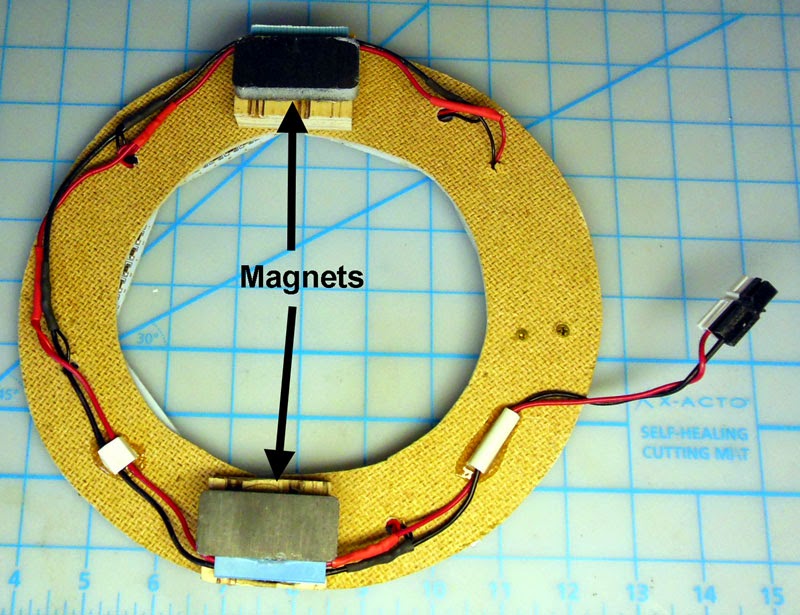
Here is the back side the the ring assembly.

Magnets were attached to the back side with adhesive and all of the lighting modules were wired in parallel with an Anderson Power pole connector at the end of the chain.


Here is the completed ring installed in the lamp.  The magnets are strong so just the two of them hold it in place.  The handle was first put on to help remove the ring but it was also helpful in getting the ring into the right position.

The base of the lamp had a small box that contained the ballast transformer and this is where the AC cord connected.

I removed the AC cord and transformer, then connected the output of one of the power supplies that are being used for the layout lighting.  It's a bit of an over kill for the 7 modules.  The power supply was then mounted to the base of the lamp with adhesive.

The push button that had been removed was replaced with a simple ON / OFF toggle switch.

As can be seen in this photo the 7 LED modules provide plenty of light, I would say at least as much as the fluorescent bulb did.

In this view I think it looks a bit like an alien space ship.


Monday, April 27, 2015

First completed section of LED lighting

It's been a few months since I've updated what was going on with the LED lighting but I have been sporadically working on this so here's an update.

I found the type of power supply I wanted on ebay for about $6.50 including shipping.  They are rated at 5 amps but plan to only load them at 50% of capacity.

This is inside one of the cabinets that are above the layout.  When I built the room I placed several of these outlets around the room that are controlled by a wall switch separate from room lighting.

When I set up the first few of the panels I had made up with 5 LED modules, it was way too bright.  So I removed 2 of the modules reducing the lighting by 40%.

Shown here is a completed 10 ft long section of LED lighting using 24 LED modules mounted 3 each on 8 panels.

As I have worked on the staging yard the first section of LED lights under the cabinets have been used to light the area so they've gotten a good testing.  So far, so good.

Here is the front on view of part of the area covered by this lighting.  The upper deck is where going to be where the cloud sky board is located.  Lately I have been using this area to photograph items for ebay listings.

The staging yard is below that and is shadowed by the upper deck so it will have need to have it's own lighting mounted to the bottom of the upper deck.

The blue strip below the cabinets is a test valance I made from tempered hardboard.

Sunday, June 15, 2014

Continuing development of LED lighting

It's been a couple of months since I've posted anything on this blog.  During that time I've been working on my Japanese Ntrak module quite a bit and also completing some DCC decoder installations.

Where I left off last time was that I had found a great little panel on ebay that contained 48 SMD LED's and that is intended to use as replacement interior dome lighting for vehicles.  Then I tested them by taking a series of photos of one of the Ntrak modules with different color locomotive, freight cars, and building to determine if the colors would come out true.

Another thing that got accomplished with the LED panels was they got installed in the travel trailer and in May we took a little trip and they worked out quite well.   One thing I've been aware of is that women are much more critical of the color temperature of lighting and with the lights in the trailer meeting with approval of both Nona and a woman friend of ours,  I have more confidence that these little panels are going to be good for the layout.

I mentioned that I got these on ebay.  Buying them in packs of 10 gets the price down to about $2.00 per panel.  There are both the white and warm white types.  I intend to use the warm white type for the layout.  At that price point, you can't expect the best quality control.  About one out of 10 of these have the red and black wires backwards which is easy to correct.


Using these small panels, I wanted to have a way to mount them in groups which could be customized depending on the area to be covered.  Most of these will be mounted under cabinets which might be of different widths.  In the area where I am starting there are four 30 inch wide cabinets each with a pair of 15 inch wide doors.  So for this first section, I came up with a 14 inch long module holding 5 LED panels and built 8 of these to match that section of cabinets.  One of these units is shown in the photo below.


This next photo shows some of the construction details.  The mounting brackets are made from brass strip and angled so that the light is not shining in the operators eyes.  The angle is only slight so the vertical space needed for the lights won't change much.  The angle can also be adjusted by bending the brass mounting brackets.  The planned 3 inch valance placed along the bottom of the cabinets will cover the height of the modules.  Notice how the second panel from the left is wired backwards.  That is how I corrected for the ones that were wired backwards on the panel.


Some calculations


Now that I've got an idea of how to use these LED panels, I needed to determine how many it will eventually take to light the entire layout, how much they will cost, how much power they will consume, what type and how many power supplies will it take to light them all up.

First the cost:
The planned visible mainline run which would receive full lighting is 62 feet.  At 4 panels per foot thats 248 panels needed.  That's over 11,000 indiviual LED's !  At $2.00 per panel, it's going to run about $500.00 spent over time.

Then the Electrical:
I had measured the current drawn by a single 48 LED panel at 75ma with 12 volts applied.  With 5 panels on each of these modules, a single module would draw 375ma.   8 modules on this 10 ft section of layout would then draw 3 amps.  I've seen a lot of laptop power supplies on line and in my local electronics surplus store rated at 5 amps and my next step will be to pick up one of those to try it out on this first section of lighting.

Monday, April 14, 2014

Experiments with LED lighting

With this layout being in a garage without any air conditioning, I was really concerned about any waste heat being generated by the room and layout lighting so LED lighting for the layout really seems to be the way to go.  I am already lighting the room with LED fixtures and that has work out really well so far.  The technology is hitting main stream lately with the products becoming more practical and more affordable.

I was also concerned about using lighting that would make the layout look good, like natural light.  Setting up a couple of those little LED light panels shown in the last post, I thought things looked good but did not really trust my own color perception completely.

Having noticed in the past that a camera sometimes sees things that my human eye does not, I took some photos of my Ntrak module to test how true different colors are represented under this type of lighting.

Using various locomotives and rolling stock, I was able to check a wide range of colors and have quite satisfied with the results so far.  All of the colors shown in these photos appear very true to the actual items.

So if I use this type of lighting, how many will I need for the whole layout ?

And how many 12 volt DC power supplies ?

These are the next questions that will need to be answered.

Monday, March 17, 2014

Evolution of LED lighting for layouts

From the first time I saw a bright white LED in a locomotive I have been fascinated with the idea of using them to light model building interiors, street lights, vehicle head lights, or anything else where a light bulb would be used on a layout.  Another area that I have wanted to use these is for layout lighting.

With this layout being in a garage without any air conditioning, I was really concerned about any waste heat being generated by the room and layout lighting.   The technology is hitting main stream lately with the products becoming more practical and more affordable.  The room that the layout is in is lighted with 3 LED light fixtures with great results.  To light the layout itself, here are some products I've experimented with.

It must have been about 10 years ago now that I picked up this set at Ikea for about 35 dollars to use under some cabinets to light part of my California Northwestern layout.

While this did work rather well to light up a small part of that layout it were not practical due to cost.

I got this 18 foot long LED rope light for about 10 dollars at Costco last year.  The price was better but a single rope was not going to give off enough light so it might take several of these running side by side to light an 18 foot section of the layout.

Looking for LED replacements for the interior lights in our travel trailer I found this product on ebay. There are a total of 48 LED's on a small circuit board with a 2 pin connector.  The kit includes 3 different types of automotive bulb type bases with connectors.  After buying a few to try out they seemed very promising so I bought a larger order and was able to get them for about 2 dollars each.


In my next post I'll show what I've been doing with these to further determine their sustainability for lighting my layout.