Showing posts with label details. Show all posts

Tuesday, March 10, 2026

Truck trailers for the grocery warehouse

A key visual feature I wanted to create in Lovelock at the grocery distribution warehouse was a large truck loading dock area with trailers parked at the dock doors and also in the lot.  This facility receives products both by rail and truck then ships by truck in company branded trailers.  The trailers delivering products could be from various freight companies but I needed to create some IGA trailers for this warehouse.

Years ago I had a Cannon printer that I got really good decal prints from.  When it died I replaced it with an Epson that I never got as good of results from.  The Epson got replaced last year with a Cannon G5020 but I had not yet tried to print any decals with it.  Recently I had purchased some decal paper that is supposed to be compatible with this specific printer.  So the first attempt was some IGA logo decals of various sizes to use on these trucks. 


I was so impressed with the way these came out I then made another sheet of decals with some trailer numbers and some colorful grocery store related graphics.  Both sheets were sealed with a spray coat of  Krylon Crystal Clear.


I painted and decaled 5 of the old Atlas generic 24 foot trailers models and 1 of the 40 foot models. Got those painted in white after first washing and applying a coat of gray primer.  Then the decals were applied and all the trailer bodies were given a coat of Dullcoat.


In the next post, I will describe what I did to improve the chassis parts to these trailers.

Friday, November 1, 2024

Renting a U-Haul in a small town

U-Haul rental trailers and trucks have been part of the American scene since the mid 20th century and nearly everyone has rented one at some point in their life.

Years ago I was making cast resin N Scale U-Haul trailers.  It all started with me making replicas of our Ntrak club's trailer and giving them to the members after finding out that it was a retired U-Haul.  After that I made several different versions of U-Haul trailers shown in the photo below and and also painted and decaled cast resin trucks and vans from Lineside Models.  I sold many of these on ebay but kept a few for myself.

From left to right: 5x8 in the older paint scheme, our Ntrak club trailer was like this one. 6x12 in the older paint scheme.  6x10 in the super graphics scheme that started in 1988.  And 5x8 in the super graphics scheme.


On a club module I had built a U-Haul rental center using several of these trailers plus some of the Lineside Models cast resin trucks.  Rental centers like this are common in larger cities and towns.

In smaller towns where there might not be enough business to support a rental center, various types of existing businesses are authorized U-Haul dealers.  The most common types of businesses that become U-Haul dealers are gas stations and self storage facilities and tool rental centers.  So, on this layout the Sinclair gas station in Carlin has become a U-Haul dealer.  

As I have both the pre and post 1988 versions, I will use the older models in the two earlier eras of the layout and a mix of those plus the 1988 super graphics versions in the 1988 to 1996 era.


Sunday, October 6, 2024

A gas station for Carlin - Part 3

Welcome to part 3 of this saga of me building a gas station.  The summer between my junior and senior year of high school, I worked just about full time at a gas station so I am drawing on my memories of that summer to add details to this gas station scene taking advantage of the height of the layout and viewing angle.

My plan is to have at least one of the garage doors open and to light and detail the interior of the garage.  Some of the details seen this this photo such as the tool chests, locker, compressor, and tire rack are scratch built from scraps of styrene. The lift, tanks, and the floor jack are details left over from other kits.


The office area of the building is also getting some interior details.  The chairs are from a Faller set and the remaining furniture is cobbled together from scraps of styrene shown here before being painted.  The bathroom area will not be seen and will serve as the place for the wires that power the lighting to go through.


When I add lighting to buildings, I often use left over locomotive LED boards from the many DCC installations I have done.  In this case, I am using the just the boards replacing the original LEDs and resistors to get just the right amount of lighting.  Surface mount LED's are being used because of their small size.  The garage gets two LEDs mounted on a scrap left over from a kit.  This assembly will rest on small blocks attached near the tops of the walls.  One of these is visible in the upper right hand corner in the photo above.


Here are all the assemblies with the lighting now added to the structure and viewed from the bottom.  With the stiffer 22 gauge wire going through the hole in the bench work I decided to add a small magnet in the bathroom section that will mate with a washer on the floor to stabilize the structure within the perimeter.

And here is the structure assembly set in it's place before the roof sections were added.  The small 30 gauge decoder wires are soldered to the PC board in the upper left corner of this photo and that board has a pair of 22 gauge wires that will connect to 12 volt DC power under the bench work.


And here is the effect of the interior lighting.  The pump island has now also been finished and glued to the base.  Next will be installing the roof and this project will be almost finished.


Saturday, July 6, 2024

Rooftop details for houses

Depending on the layout height, the roofs of model buildings are often more noticeable than they are in real life.  In a recent post, I showed how I used some available 3D printed parts to detail the roof of a commercial building.  Link to that post HERE.  The roofs of houses can also have some detail added although they are somewhat more limited and different.  Here are a few things I've recently done to the roof of a single story 3D printed house kit.

If the model has a simulated shingle roof made from plastic, a weathering wash will help bring out the detail.  Even if the rest of the outside of the house is not weathered, the roof should be.  Something that can be added to the roof of a house are plumbing vents.  I made these using .035 styrene rod and glued them into holes of the same size.  In the photo below I decided that all of the plumbing was toward the back of this small house.


By the late 1950's most homes had some sort of television antenna on the roof.  While that is a tiny and you would think very delicate detail to have on an N scale building, a nice sturdy product has been available for over 30 years from Gold Medal Models.  I bought a set like this when they first came out and recently purchased another set as I had used up all 20 antennas over the years.


These antennas have a tiny hole to insert the mast into.  .010 wire works well for a mast and a drop of super glue will bond the antenna and mast.  I placed the antenna on this house next to the chimney as often these antenna masts are mounted with straps to the chimney.   In the photo below the antenna is mounted and the plumbing vents have been painted a dull silver color.  If the house is more modern then the vents can be painted flat black as this pipes are now mostly ABS plastic.


Saturday, March 9, 2024

Improving some Wiking VW models

A quick break from the structure building posts to work on some vehicles.

I have a bunch of old Wiking models of Volkswagen vehicles that were given to me by a friend years ago when he tore down his layout.  These models have great accurate bodies and solid clear plastic windows but lack any type of realistic paint detail, particularly on the tires.   Because of this I have never really used them on any of my layouts or modules.  The beetles and vans in particular were quite common in the 1960's and 70's so I decided to get some of them out and do something with them.


These models come apart easily.  There are just 3 parts: The chassis in a silver or gray color, the body in various colors, and a solid clear plastic part to represent the window glazing.  After getting these apart, I painted the tires black with Mission Models tire black acrylic paint.  When those had dried, I painted the bumpers with Model Master silver acrylic paint.


For things like hubcaps, headlights, tail lights, door handles, etc. I use Sharpie pens. These are available in an assortment of colors.  This can be done either before or after re-assembling the vehicle.  I store the pens in a zip lock bag in an effort to keep them from drying out.


These now look much more realistic and I am happy to have them on the layout.  I just did these two for now and still have quite a few more.  Next batch I want to try painting the bodies in some colors I remember seeing and with the van getting a two-tone paint job with the white on top which was common.


Saturday, March 2, 2024

Finishing a 3D printed house

This 3D printed house is something I purchased a couple of years ago along with two others.  All three are based on the design of the Sears catalog houses of the early 1900's.  The one I am finishing here was the largest of the three and I intended to use it to house the speaker for the grade crossing in Carlin.  This particular house had a total of 5 pieces, there shown in the photo below after they had been sprayed with primer.  There was also a base and a small roof section not show here.


This is what it looked like after painting.  The small roof section is also present in this photo.  Painting these is similar to painting a Design Preservation Models (DPM) building.  I started by air brushing the base color then brush painting the trims and any details.  On this model I painted the chimney and the foundation walls a red brick color.  


There had already been a base prepared for this scene made from fiberglass reinforced plastic paneling.  Here is the completed house glued down to the base with a car port and other surrounding details being added.  The wire and plug sticking out on the right side of the base is for the grade crossing speaker. 

After installing the fences and more details at the work bench here is the completed scene installed on the layout into a recessed area that is surrounded by styrene strip with the scenery built up around the outer edges.  I still want to add a tree or two and that or other changes will be easy as this entire scene is removable. 


Sunday, February 11, 2024

Finishing a re-cycled fire station

On my last layout which was from 2002 to 2013 I had a California Department of Forestry fire station which I built from a Rix Products kit.  If I had taken any photos of it on that layout I can't find them now.  When researching things for this layout I found that the fire station in Carlin was of a similar design but with an extra door.  Since I still had the old model, I decided to use it again on this layout but with some upgrades.


One of the things I wanted to be able to do with this structure was to pose each of the doors either as opened or closed.  The solution I came up with was to use Velcro on the back of each door and on the inside of the roof of the building to store the doors when they are open.  The fit of the doors into the wall is snug enough that they don't need any glue to stay in place.


The building sits on a removable base that has blocking of styrene strips around the inside of the walls that hold the building in place.  The building can be easily picked up to change the position of the doors or move around the fire engine models.


Some of the details added were rain downspouts made of .035 styrene rod added at each corner of the building and some signs that were made on the computer and printed on paper.  I only have a couple of fire engines right now representing different eras but plan to add more in the future.  As the layout is modeled in different eras from the mid 1970's to mid 1990's I plan to have at least 2 set of fire equipment that can reflect those different eras.


Thursday, September 7, 2023

Scrap yard fencing

I have been continuing work on the scarp yard in Carlin and wanted to create some fencing similar to what I had seen around such places. I started with some corrugated foil material that I have used to make roofs on some structures.  A little package of this material was my first ebay purchase back in 2001 and has been used on several projects over the years.  This material was cut into 10 scale feet high strips.  The one shown in the upper right of this photo is how shiny it is so I painted them a duller aluminum color and dry brushed some weathering on them.


Coiled razor wire at the top of the fence was made by winding 30 gauge magnet wire around a bamboo skewer.  This was then painted a silver color before being attached to the top cross frame of the fence with Super glue.


I built frames for the fence from .030 x .030 styrene strip painted roof brown before attaching the simulated metal sheeting.  This photo shows this in the section that has the gate for the track.


The foil material was then attached to the frame with tiny dots of E6000 adhesive using a bamboo skewer.  The foil material is nonconductive and since the frame is made from styrene, there is no chance of shorting the rails.


The gate is supported by a single pin at one end that is not glued into the base so the gate can swing open.  The spacing was set so that freight cars and locomotives can pass through without hitting the fence.


Still plenty more to do to finish this scrap yard.  More in future posts.


Sunday, June 11, 2023

Scrap metal piles

The scrap yard industry I am building on my layout will need some piles of scrap metal as the source for loading rail cars.  The process I used to create a large pile of chopped up scrap steel is similar to how the gondola loads were made.   Because of how large this pile would be I started with a piece of 3/4 inch plywood cut to the desired shape and then shaped further with a belt sander to get what is shown in the photo below.


This wood block was then painted a flat black color which made it look a bit like a pile of coal.


The wood base does not work well with the liquid PlasticWeld so an initial layer of plastic pieces were attached to the wood block with Super Glue.  Additional layers were then added using the Plasticweld.


Once the layers of plastic scrap were finished, the entire pile was brushed with a watered down rail brown paint so it would soak down into the spaces.  If anything is left uncovered the black base of the wood block should make it not so noticeable.   Next the entire pile was given a light spray of rust colored paint.  Once that dried individual pieces of scrap were dry brushed in various dull colors, and the pile was given a coat of Dullcoat.  On this one I also added some weathering powers.


Here is another smaller scrap pile I made using clear plastic from a water bottle.  This was the one I had some trouble with the glue and paint sticking.


Monday, June 5, 2023

Scrap metal loads for the gondolas

One of the products my scrap industry ships by rail is carloads of metal scrap separated by type and grade.  Not having exactly what I wanted in my stash of cast resin loads, I decided to make my own. This load will be for steel scrap that has been chopped up.  I needed some thin plastic and is was suggested that I try plastic bottles as a source.  I tried that first and it looked good but I had trouble with both adhesives and paint sticking to it.  What I have had nice results with is the type of plastic from a food tray like the one shown below.


The load was built on a scrap of clear acrylic plastic cut to fit inside the gondolas.  I drilled a hole in the middle and glued in a cut off roofing nail so the load could be picked up with a magnet.  Gluing a thin piece of steel to the acrylic base would also.


The top surface of the acyrilic was painted flat black.  The black plastic tray material shown in the first photo was cut up into small pieces which were about 2 to 3 scale feet square. This material works well with Plastruct Plastic Weld.  In the photo the process is just started and can be built up to whatever depth is required.  Looking carefully in this photo part of the round head of the roofing nail can be seen.


After building up the scrap to the desired depth, I brushed on a heavy coat of rail brown that was somewhat diluted so it would run down into the small spaces.  After that dried I airbrushed a light coat of rust and after that dried, I dry brushed some lighter colors on some of the individual pieces.   The photo below shows the finished result.


As was envisioned, the load can be easily removed using a magnet without having to remove the car from the track.  In this photo it can be seen that much of the overall thickness of the load is made up from the thickness of the acyrilic base.  This load is about 3 scale feet thick.


Friday, November 4, 2022

3D Printed Wheel Stops

Almost a year ago I learned about some 3D printed wheel stops from The Little Rock Line blog.  So I ordered them from an Etsy seller.  This was my first purchase on Etsy and have noticed that it seems to be a good source for N Scale 3D printed items and more reasonably priced than items on Shapeways.  I have since ordered a few more items on Etsy from this same seller and others.  Selection is not a large as Shapeways but hopefully will expand over time.

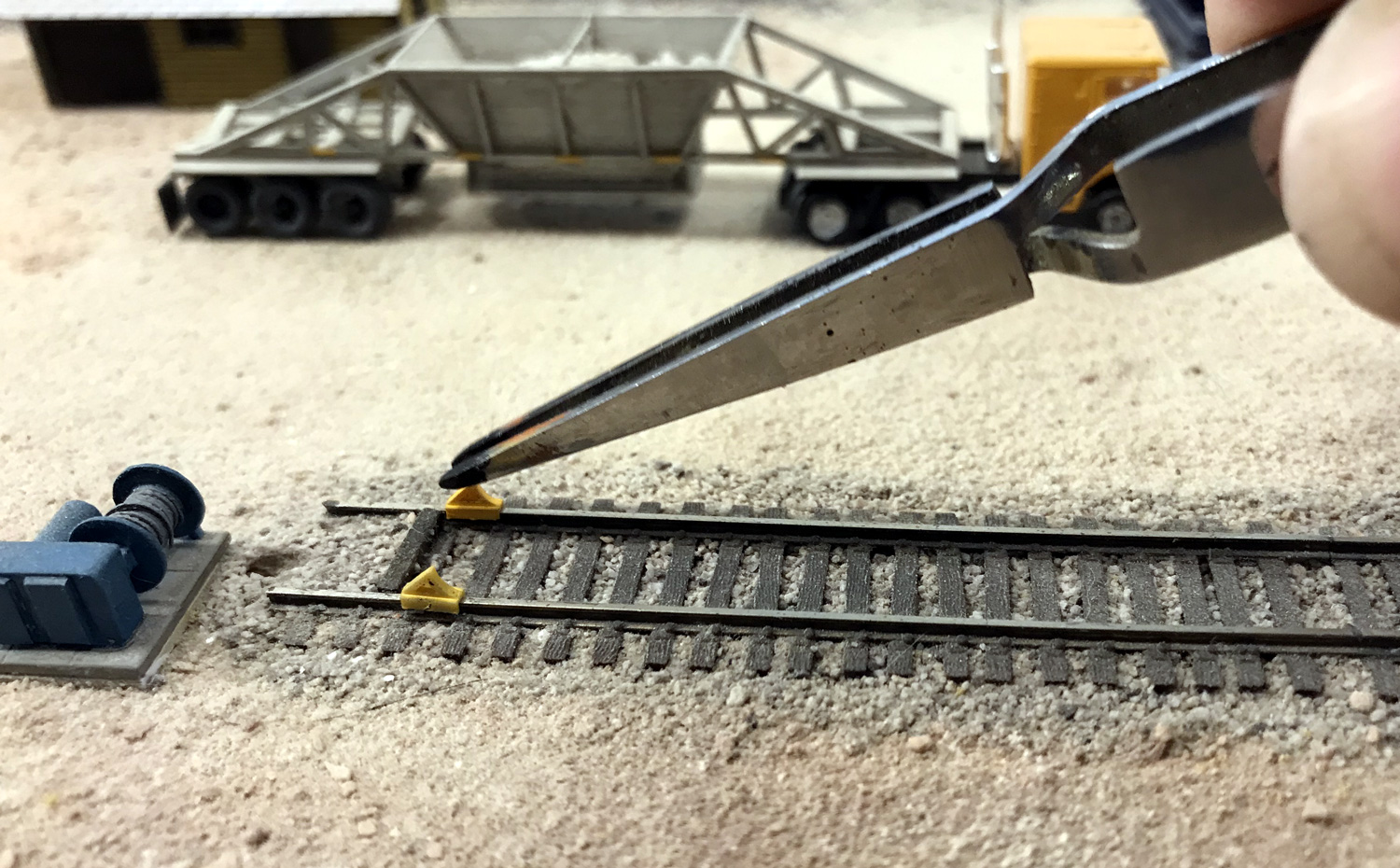
So just recently I got around to painting and installing these.  They come 12 in a pack consisting of 3 groups of 4.


Each wheel stop is mounted on 6 of the little posts that are common on 3D printed items.  I painted these with a brush before removing the wheel stop from the posts.  There is a little channel at the bottom where the wheel stops meet the posts so care was taken not to damage the channel.


After cutting the posts off with a spue cutter, I filed smooth any nubs left on the edges of the channel.  Installing these just took a small drop of super glue on the rail and then the channel fit right over the rail.


These wheel stops have been installed at the ends of 6 out of the 9 spur tracks on my layout.  The other 3 have some end of track bumpers that I scratch built from brass

Tuesday, August 2, 2022

Grade crossing in Carlin

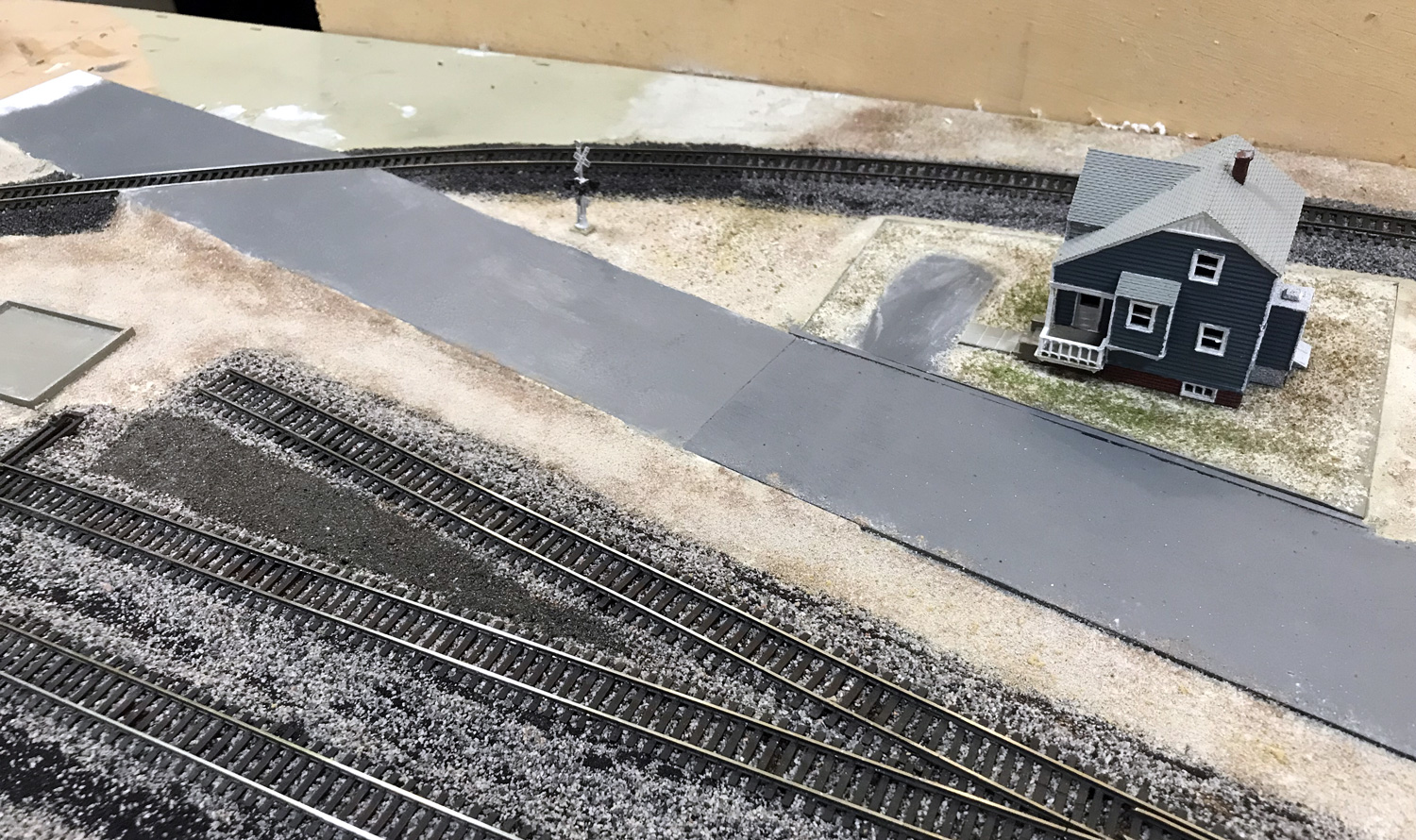
In the real Carlin, there are a pair of multi track grade crossings, one at 4th street and another at 10th street.  I wanted to keep my small modeled yard clear of any grade crossings but did find a spot where Main street crosses the Western Pacific line to include one of these interesting features.

The grade crossing that I had set up in Battle Mountain a few years ago was no longer working correctly but the signals themselves were OK so I transplanted them to Carlin.  These NJ International signals have lights on both sides and as this crossing would be visible from both sides I wanted to use them here.  When I rebuild the crossing at Battle Mountain I plan to scratch build some signals that will only have lights on one side as they can only be seen from the front.   In Carlin I am using the crossing controller from Azatrax with the IR transmitter and receiver being in between the ties using the reflective mode.  For the sound I am using the ITT Products grade crossing module.  These circuits are mounted under the bench work.


The instructions that same with the sound module recommends a speaker with an 8 ohm input impedance.  For about $5.00 each on Amazon I found some 2 inch, 8 ohm speakers.  I am impressed with the sound quality from these.


These speakers are also small enough to hide in a small structure.  This one will be in a 3D printed house that is nearby the crossing.  I still need to get the part between the rails done and also some markings on the road.


When I set up this signal, this section of bench work was still on the saw horses and everything worked great.  After installing the section into the layout the sensors started to get false triggers.  What was happening was that the invisible IR beam was reflecting off the bottom of the cabinets which are 17 inches above the track.  I taped up some of the same black craft foam that I used on the roads and that seems to have solved the problem.  So I may need to either attached these foam sheets more permanently or paint the bottoms of the cabinets a flat black in this area.