Showing posts with label Freight cars. Show all posts

Sunday, August 11, 2024

Weathering a couple of Conrail covered hoppers

In the operating scheme of the layout, Diamond Plastics in Battle Mountain receives car loads of plastic pellets from the east coast.  I found that I had a shortage of eastern railroad's covered hoppers in the correct era.  I did have a pair of Delaware Valley cylindrical covered hoppers in Eire Lackawanna that I felt were too old to fit in my 1975 to 1995 layout era.  Then realizing that the Eire Lackawanna was adsorbed into Conrail in 1976, I started to do a little research on these cars and found photos of these type of cars being in service with Conrail at least into the late 1990's.  In this photo below, an old PRR keystone logo can be seen showing through just to the left of the Conrail logo.


So, the Conrail era of 1976 to 1999 fits right in with my layout and they inherited many of this type of freight car from their predecessor roads including the Erie Lackawanna.  Seems the Pennsylvania and Eire Lackawanna cars were this mineral red color but some later were painted light gray by Conrail. The road numbers assigned to these cars by Conrail seemed to range from about 884500 to 884950.  For these cars I want to model them before any re-painting had been and just patched with the new Conrail road number. 

The first step I took in weathering these cars was to fade the "Erie Lackawanna" road name in varying degrees.  I used a soft eraser pencil dipped in Microscale Micro Sol and rubbed off the lettering part of the way.  Photo below shows before and after.

The next step was to use black stripe decals to black out the existing Eire Lackawanna road number.  I did this with some black decal stripe.  When this had set, I then brushed some gloss finish over it to make it extra secure when working with the road number decals that will go on top of it. 


 I could not find any photo of a car known to have been a former Eire Lackawanna car so the road numbers chosen were from within the range of similar Conrail cars that I had seen in photos.  The lettering for the road numbers was taken from a Microscale white numbers and letters set.  I also added a data panel from another Microscale set.
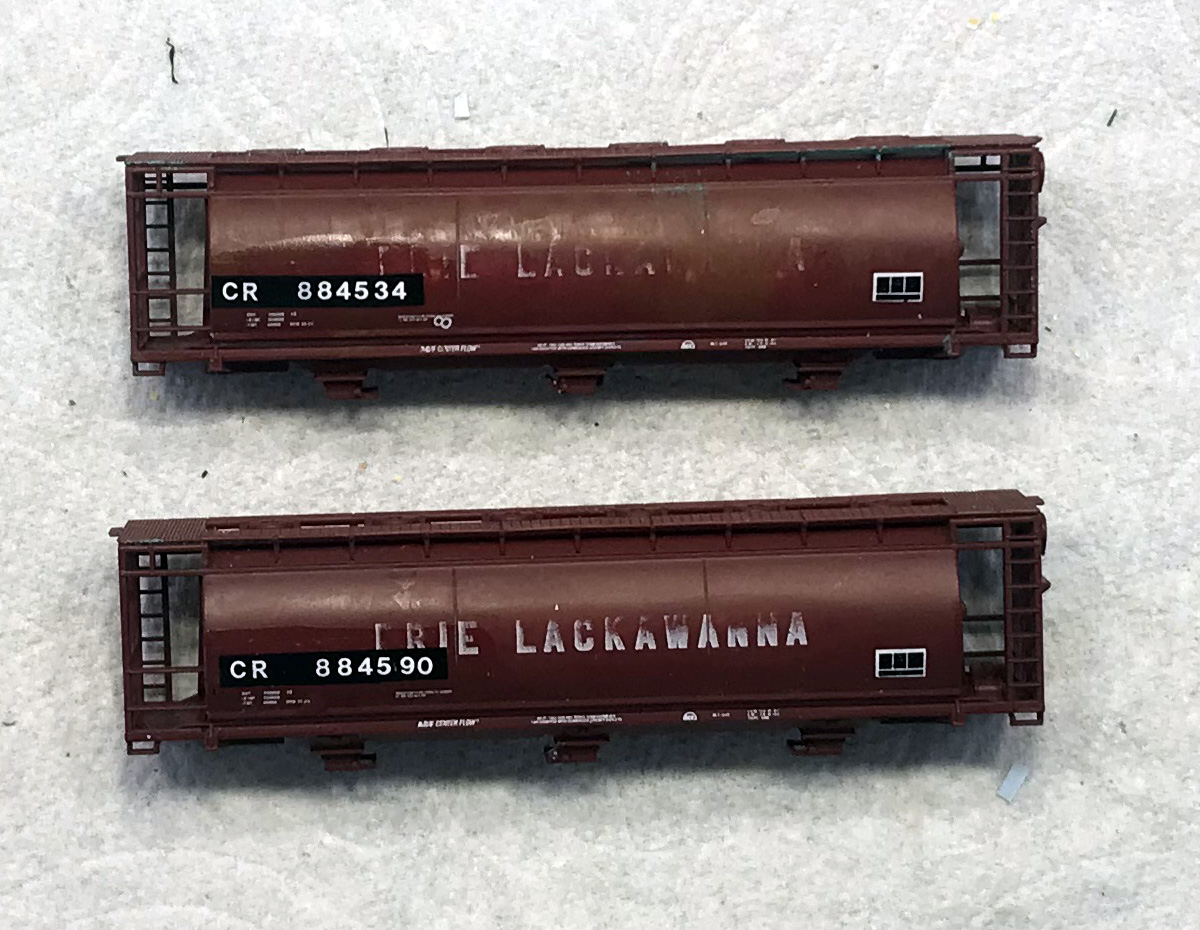


Next, I used black detail wash to weather the car bodies.  Once I was satisfied with the wash effects, the car bodies were let dry over night and I took a look at the trucks that I had pulled off of them.  They were Micro-Trains older era types with pizza cutter flanges so I pulled out 2 pairs of roller bearing types from my stash as these would be more prototypical for the layout's era.  The wheels on these had low profile flanges which I prefer for use on my code 55 track.

The wheels were removed from the trucks and the trucks were places into a holder that had made a few years ago for specifically for spraying Micro-Trains trucks.  After first spraying a adhesion promoting primer, I sprayed the truck side frames with Mission Models railroad tie brown.  After that had dried, I sprayed both the trucks and the car bodies with Testors Dulcoate lacquer.   


After installing the new trucks, both cars were given a test run around the layout and preformed perfectly.  So, two freight cars that had been sitting in the "to be sold" box and now active on the layout and are among my favorites. The two photos below show 884534 on the siding at Diamond Plastics and an empty 884590 in the yard at Carlin waiting for the next eastbound manifest to pick it up. 


Sunday, October 8, 2023

What to do with all those pizza cutter wheels

Having a layout with code 55 track, I have been replacing the deeper flange wheels on freight cars with low profile ones with priority being given to cars that have car cards and are used in layout operations.  So it's no surprise that I have a pile of the "Pizza Cutter" type wheels in my parts box.  Recently I had been making up removable loads for some of my gondolas and thought that old railroad wheels could make a nice load.

I started by cutting wheels off their axles with my spue cutter.


For a base I used a scrap of thin sheet metal cut to fit inside a Micro-Trains 50 ft gondola.


Next I began gluing the cut off wheels with liquid plastic cement.  First layer was laid out flat then additional wheels were added to the first layer.  They were all placed with the outside part of the wheel pointed up.

Similar to how I did with the scrap loads and covered the load with acrylic oxide red paint being careful get it into all the cervices. 

This is the almost finished load in a gondola.  I say almost because I still want to dry brush and weather this old to make it more realistic.  


Tuesday, August 1, 2023

Patching a patch job

During the N Scale convention held in Reno in June, Scaletrains sent out their PS-2 4785 3 bay covered hopper painted for Golden West Service and patched for Cotton Belt (SSW) to everyone who attended the manufacturers breakfast on Sunday morning.  What a nice surprise that was.  Because my wife also attended, we received two of these models with the same number so I wanted to re-number one of them.


I always like to start with a prototype photo and so looked through a bunch online.  The patches on these cars were done in several different ways.  I settled on this one although it is less weathered than the model.  While the stock Scaletrains model has a dark blue background with yellow characters, this one appears to have a black background with white characters.

.

First thing to do was to remove the original patch.  I found that with a soaking of Microscale Micro Sol and gentle scraping with an Xacto blade, the original patch comes off fairly easily.

For the black background I used some of the wider stripes from a black stripe set I had.  None of the stripes were wide enough so I doubled the rows to get the width I needed.


This is the area with the black stripes applied.  The black stripe decals were applied in between bunt not over the panel seam to match the prototype photo.  These were then given an application of Micro Sol before the characters were started. 


This is how the model looked after the characters were applied.  As the weathering on these cars was identical, I added just a bit more to this one to make them seem different.  This was a fun project.  Most prototype patch jobs tend to be held to lower standards then original paint jobs so a few crooked decals or mismatched character fonts can be forgiven.  These are great models and I'm really happy to have them on my layout.


Thursday, July 13, 2023

Removable coal loads for Micro-Trains hopper cars

Some time ago I added a unit coal train to the operation of my layout.  The SP trains would have been carrying Wyoming coal from Ogden, Utah to San Jose, California.  From there it would have gone out on locals to at least two cement quarries to be used it in their kilns. 

On this layout these trains run through without any interchange. It seemed unrealistic for them to run loaded in both directions so I wanted an easy way to remove these loads so they could be empty in the eastbound direction.  

The loads that come with the Micro-Trains hopper are good looking and fit snugly into the car and cannot be removed without picking up the car.  The loads weigh 10 grams, with the empty car weighing 18 grams so a lot of the weight is in the loads. On the bottom there are three rectangular bulges. 


First I wanted to make sure the empty cars would be not be too light and would run OK on the layout so I ran a train of 9 empty cars with several mechanical reefers on the back around the layout a few times and this seemed to work well.

I removed the center bulge with a coping saw then smoothed out the area with a sanding stick.  I originally thought those bulges might contain some metal weight but apparently it does not and the 10 grams is all plastic.  With one of the bulges removed, the load weighed in a 8 grams.


Using a sanding stick I sanded all of the outside edges until the load fit loose enough so that it fell out when the hopper car was turned upside down.  


Some 5/8 inch wide metal strip was cut into lengths.  The corners were rounded and the edges were filed smooth.


The metal strip was attached to the center area of the bottom of the load with E6000 adhesive and clamped until set.  The 2 grams lost with the removal of the center hump was made up with the addition of the metal strip and the load was back to its original weight of 10 grams.


Now with the help of a magnet, the loads easily be removed when the west bound coal train reaches the west end staging yard. 


Monday, June 5, 2023

Scrap metal loads for the gondolas

One of the products my scrap industry ships by rail is carloads of metal scrap separated by type and grade.  Not having exactly what I wanted in my stash of cast resin loads, I decided to make my own. This load will be for steel scrap that has been chopped up.  I needed some thin plastic and is was suggested that I try plastic bottles as a source.  I tried that first and it looked good but I had trouble with both adhesives and paint sticking to it.  What I have had nice results with is the type of plastic from a food tray like the one shown below.


The load was built on a scrap of clear acrylic plastic cut to fit inside the gondolas.  I drilled a hole in the middle and glued in a cut off roofing nail so the load could be picked up with a magnet.  Gluing a thin piece of steel to the acrylic base would also.


The top surface of the acyrilic was painted flat black.  The black plastic tray material shown in the first photo was cut up into small pieces which were about 2 to 3 scale feet square. This material works well with Plastruct Plastic Weld.  In the photo the process is just started and can be built up to whatever depth is required.  Looking carefully in this photo part of the round head of the roofing nail can be seen.


After building up the scrap to the desired depth, I brushed on a heavy coat of rail brown that was somewhat diluted so it would run down into the small spaces.  After that dried I airbrushed a light coat of rust and after that dried, I dry brushed some lighter colors on some of the individual pieces.   The photo below shows the finished result.


As was envisioned, the load can be easily removed using a magnet without having to remove the car from the track.  In this photo it can be seen that much of the overall thickness of the load is made up from the thickness of the acyrilic base.  This load is about 3 scale feet thick.


Thursday, June 1, 2023

Creating a pair of RailGon gondolas - Part 2

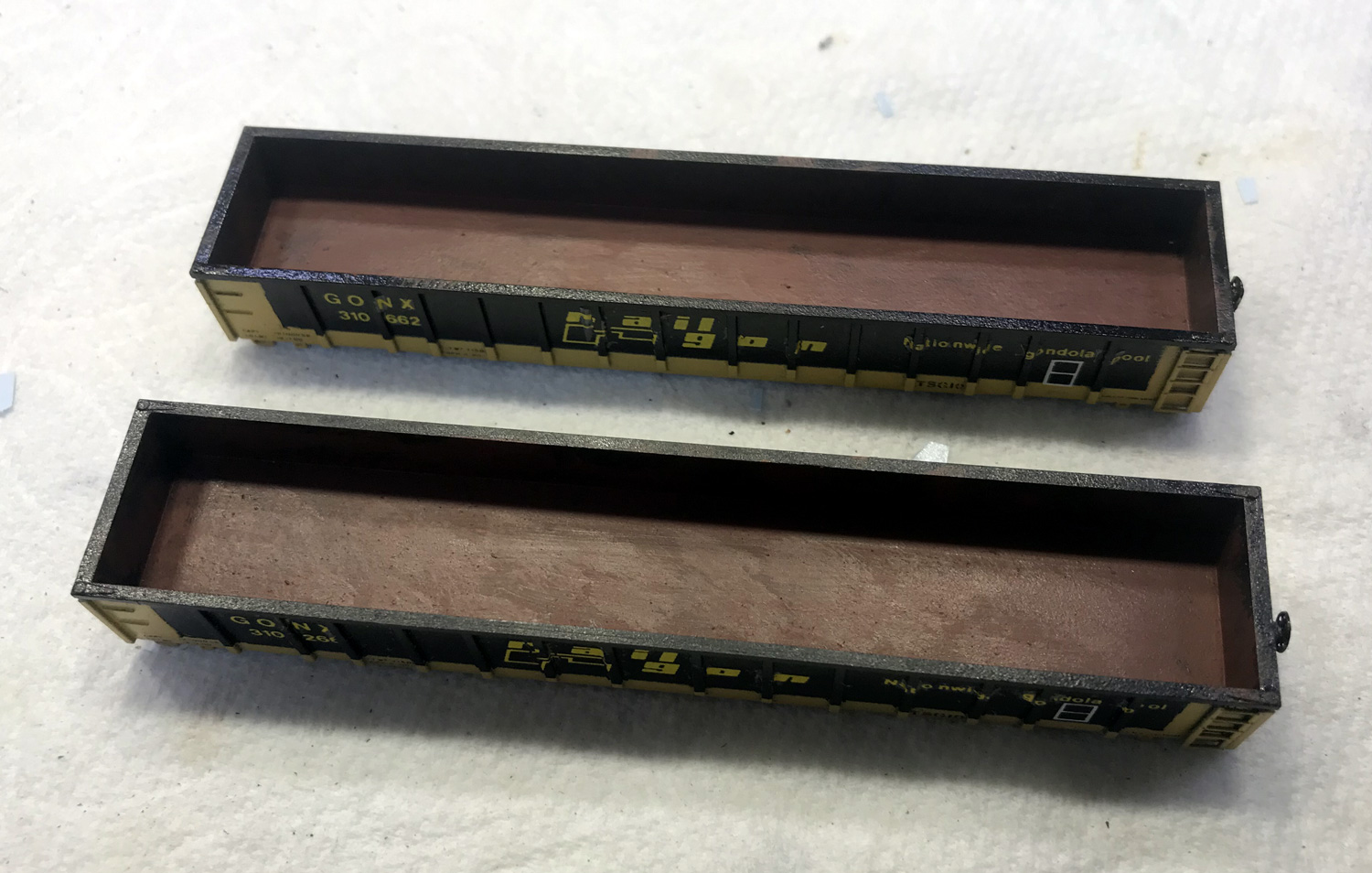
It took quite a bit of time to do the decals but then it's something I enjoy doing.  The larger decals had to be carefully manipulated around the pillars.  The decal set came with decals for 2 RailBox box cars but only one set for the RailGon so I used two decal sets.  The stock road number is 310266.  I moved the numbers around on the second set to make the second car's road number 301662.


The floors of the gondolas were brushed with rail brown and then dabbed with a small sponge brush to give it the texture seen here.  The inside walls were given the same treatment only lighter with some of the black showing through.


After a spray of Dullcoat, 310662 got some light weathering and 301266 got a little heavier weathering.


I had some nice low profile metal wheels that fit the Atlas trucks so kept those trucks and their couplers and sprayed the side frames of the trucks with rail brown and installed those metal wheels.  These roll really well and these two gondolas are now ready for service.  These 52 foot cars are just a bit longer then the cast resin loads I have for the Micro-Trains 50 ft gondolas .  So the next project will be to make some scrap metal loads for these. 

Monday, May 29, 2023

Creating a pair of Railgon gondolas - Part 1

As I have gone deeper into the operations of the layout, I have been trying to gather the correct cars for each of the industries.  One of the considerations is a railroad's preference to deliver one of their own empty cars to an industry for loading.  When looking through the 14 Micro-Trains gondolas in my collection, I found that I had only one Southern Pacific.  I then did purchase a recent release of a Cotton Belt model.  Golden West was a subsidiary of the SP and I was also able to purchase a Micro-Trains Golden West gondola on ebay.

And then I started looking at some lease / private owner gondolas.  I really liked the RailGon gondolas, and Micro-Trains has done a few of those but I have not been able to find any.  Athearn and Con-Cor have also done them but looking at the photos I was not happy with the quality of the paint work, specifically the blurry lines between the black and yellow along the bottom.


At a recent club open house I picked up a pair of Atlas models of the Thrall 2743 gondolas for $7.00 each.  These are not quite the exact model as the prototype photo.  The prototype has 14 panels and the model has 15.  However the models are the correct length and the pillars between the panels appear to be a good match so I decided to try to create may own RailGons.


This particular decal set is no longer offered by Microscale but I was able to find two sets on ebay.


The trucks were removed from the plastic body and metal chassis.  The chassis and body seemed securely attached and I did not attempt to separate them.   I soaked the body / chassis a paint stripper from the hobby shop, then washed in warm water scrubbing with an old tooth brush. 


When the paint removal was done I was surprised to find that one of the models was molded in black plastic and the other in gray plastic.


To have something for a clip to hold on to, I attached a scrap of plastic to the deck of the gondola with E6000 adhesive.  This can be pulled off later without damaging the model.  The gondola was then air brushed with Model Master gloss black.  After letting that dry overnight I masked that areas that would remain black and sprayed with Trailer Train yellow.  I had at first attempted to wrap the tape around each pillar to get a clean line but had trouble keeping the line straight so the tape was just applied to the surface of the pillars in a straight line. 


After just a bit of touch up with a small brush, this is what I ended up with.  I am satisfied with the result of the separation between the black and the yellow along the bottom which is what I had noticed was blurry on the Athearn and Concor models.


This is the end of part 1, I'll continue this project with decals and finishing in part 2.

Wednesday, May 24, 2023

Securing Micro-Trains HUMVEEs to flat cars

 In a post from a couple of years ago, I showed how I had modified a pair of undecorated Micro-Trains 89 ft flat cars to an F226 configuration with wood decks and hold down tracks in the decks.  A link to that post is HERE.  30 gauge magnet wire was used to create a way to connect the end of the chain to the vehicles.  It was looped through the end link of the chain and twisted.

A .022 drill bit in a pin vise was used to make a hole in the chassis section just inboard of the tires. 


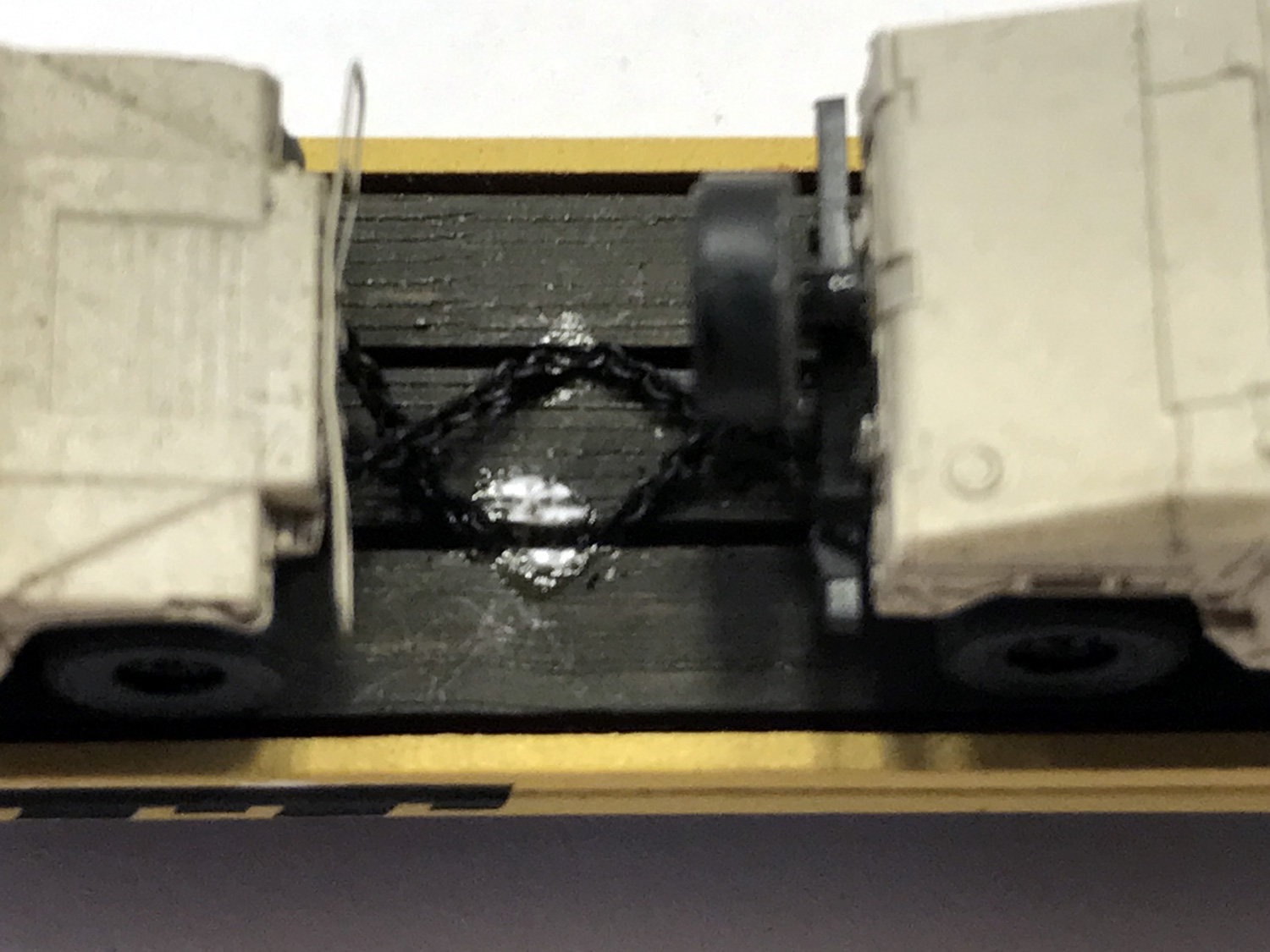
This next view is looking from the top of the chassis section.  The twisted end of the magnet wire was inserted through each hole from the bottom with its length of chain.  The ends of the magnet wire sticking through the top the chassis were bent over and a drop of super glue was placed on each of these. 


After the super glue had set, the copper magnet wire loop that sticks out of the bottom of the chassis with the chain attached was painted with gloss black paint to blend in with the chassis.


A small amount of E6000 adhesive on the inside edge of each wheel was used to secure the vehicles to the flat car deck.   After the adhesive had set, the loose ends of the chains were inserted into the hold down tracks modeled as slots in the wood decking.   A drop of super glue was placed on the ends of the chains to secure it to the deck.  After the super glue had set, the deck was touched up with roof brown paint to get rid of the shiny spots of glue.

I mounted 4 Micro-Trains HUMVEE models on one of my F226 flat cars this way.  3 of these are modified models and 1 is stock.  In the near future I plan to load up the other F226 flat car this way.


Thursday, January 26, 2023

New decks for bulkhead flat cars

I recently installed some new, more realistic looking decks on my bulkhead flatcars.  I purchased these directly from Micro-Trains.  They appear to be printed images on thin, laser cut wood.  One package is enough to do 3 cars with each having separate pieces for the main deck and the bulkheads.

After taking them out of the package and separating the parts I found the main deck piece to be just a bit too long for the decks on my cars.


This was corrected by sanding down just a bit at each end of the deck. 


The edges to me looked a little too light when I test fitted the decks on the cars so I darkened the edges with a black sharpie pen.


Avery stick adhesive was used to attach the deck pieces to the car.


Here is a comparsion of one of the finished cars and another one yet to be done.  I am pleased with the results and since I don't currently have many loads that I would place on these cars having a more realistic deck makes a difference.