Monday, August 26, 2024

Layout visit - Silicon Valley Lines

On Saturday, August 24th I visited the Silicon Valley Lines HO Scale layout in downtown San Jose.  I have wanted to visit this layout for some time but somehow never had gotten around to it until now.  A few weeks ago I received an announcement for an open operating session and signed up. 

This club alternates between modern and transition eras which they define as being after or before the start of Amtrak in 1971.  For this session they were in the transition era.


This layout is using plenty of technology, some of which is new to me.  It was all DCC using the NCE system with boosters and many power districts.  They are also using LCC for some of their turnout and signal controls.  The layout is almost fully signaled.


What was different was the fact that some of the operators were remote.  A couple of the trains running had camera cars in front of the locomotive so the remote operator could see where they were going.  I was told that one of these remote operators was in the UK and that the dispatcher was in New York.  On one of my jobs I even made an opposing meet at a siding with one of the remotes.


During my visit I ran three jobs.  First was a short freight train using a pair of Santa Fe GP7's in zebra stripe as power.  Next was a longer passenger train that ran over most of the layout.  As I was using my phone as a throttle, I did not get any photos while running but below is a photo of the passenger train's power that I took at the end of the run.  This club uses Chicago & Northwestern colors as the home road, removing the C&NW logo and adding their own SVL decals.  Both of these sets of locomotives had sound decoders and both runs went really well.


The third job I ran was to take 9 cars from Bayshore yard and load the car float with them.  While the first two jobs were on the main line with signals and turnouts under dispatcher control, this train was a local on a secondary line so I also controlled the turnouts.  In several places such as this around the layout there are small touch screen computers mounted with track diagrams programmed into them.  This was something else that I've seen in videos but had never used before.  I soon got the hang of it though.


It was a fun time and good to meet some modelers from another scale in our area.  The members here were quite welcoming and helpful to guest operators such as myself.  This club has a website, it's at https://siliconvalleylines.com/   There is also a professionally done TSG Multimedia video about this layout on YouTube at https://www.youtube.com/watch?v=jeoH92UYrrg

Sunday, August 11, 2024

Weathering a couple of Conrail covered hoppers

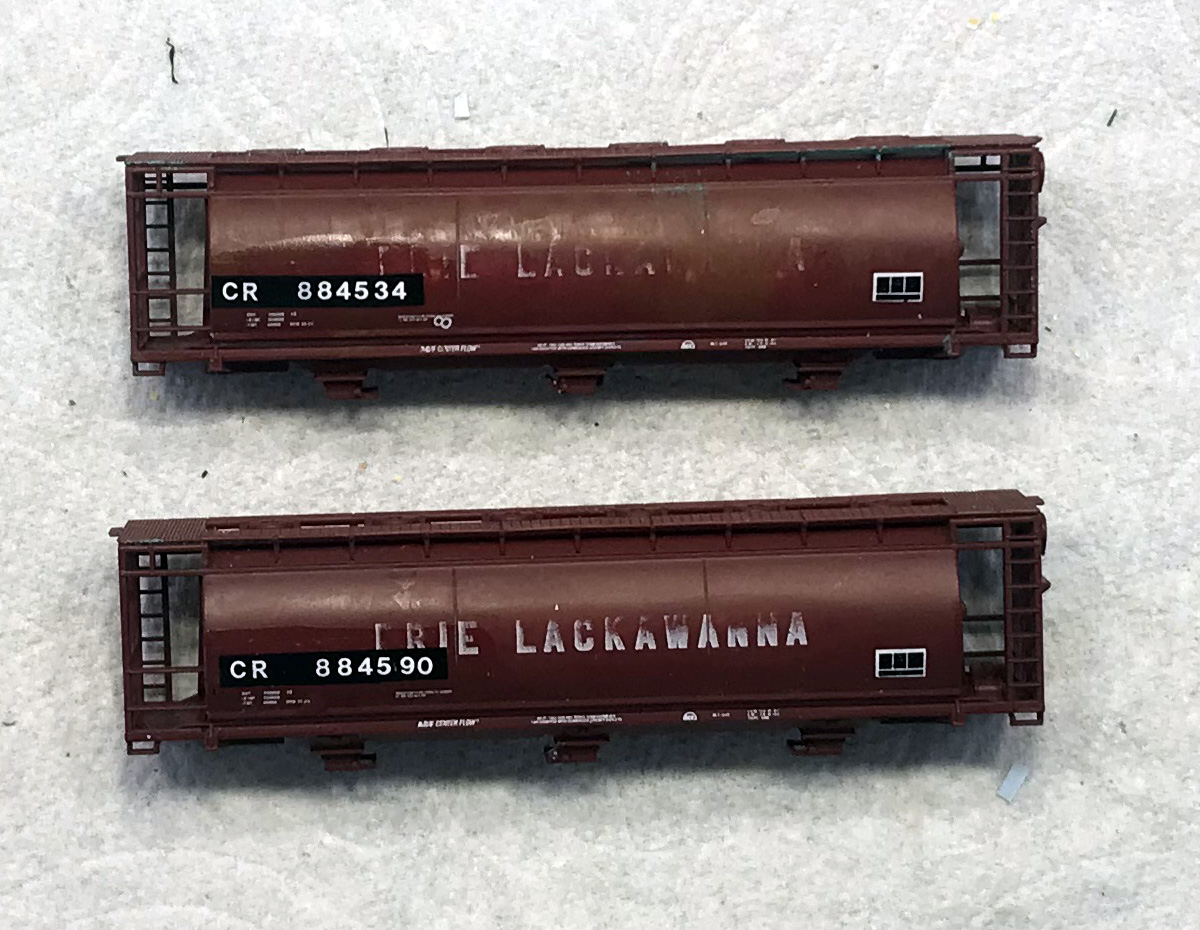
In the operating scheme of the layout, Diamond Plastics in Battle Mountain receives car loads of plastic pellets from the east coast.  I found that I had a shortage of eastern railroad's covered hoppers in the correct era.  I did have a pair of Delaware Valley cylindrical covered hoppers in Eire Lackawanna that I felt were too old to fit in my 1975 to 1995 layout era.  Then realizing that the Eire Lackawanna was adsorbed into Conrail in 1976, I started to do a little research on these cars and found photos of these type of cars being in service with Conrail at least into the late 1990's.  In this photo below, an old PRR keystone logo can be seen showing through just to the left of the Conrail logo.


So, the Conrail era of 1976 to 1999 fits right in with my layout and they inherited many of this type of freight car from their predecessor roads including the Erie Lackawanna.  Seems the Pennsylvania and Eire Lackawanna cars were this mineral red color but some later were painted light gray by Conrail. The road numbers assigned to these cars by Conrail seemed to range from about 884500 to 884950.  For these cars I want to model them before any re-painting had been and just patched with the new Conrail road number. 

The first step I took in weathering these cars was to fade the "Erie Lackawanna" road name in varying degrees.  I used a soft eraser pencil dipped in Microscale Micro Sol and rubbed off the lettering part of the way.  Photo below shows before and after.

The next step was to use black stripe decals to black out the existing Eire Lackawanna road number.  I did this with some black decal stripe.  When this had set, I then brushed some gloss finish over it to make it extra secure when working with the road number decals that will go on top of it. 


 I could not find any photo of a car known to have been a former Eire Lackawanna car so the road numbers chosen were from within the range of similar Conrail cars that I had seen in photos.  The lettering for the road numbers was taken from a Microscale white numbers and letters set.  I also added a data panel from another Microscale set.


Next, I used black detail wash to weather the car bodies.  Once I was satisfied with the wash effects, the car bodies were let dry over night and I took a look at the trucks that I had pulled off of them.  They were Micro-Trains older era types with pizza cutter flanges so I pulled out 2 pairs of roller bearing types from my stash as these would be more prototypical for the layout's era.  The wheels on these had low profile flanges which I prefer for use on my code 55 track.

The wheels were removed from the trucks and the trucks were places into a holder that had made a few years ago for specifically for spraying Micro-Trains trucks.  After first spraying a adhesion promoting primer, I sprayed the truck side frames with Mission Models railroad tie brown.  After that had dried, I sprayed both the trucks and the car bodies with Testors Dulcoate lacquer.   


After installing the new trucks, both cars were given a test run around the layout and preformed perfectly.  So, two freight cars that had been sitting in the "to be sold" box and now active on the layout and are among my favorites. The two photos below show 884534 on the siding at Diamond Plastics and an empty 884590 in the yard at Carlin waiting for the next eastbound manifest to pick it up. 


Tuesday, August 6, 2024

Chipping away at the box of N Scale vehicle kits

Like many of us in N Scale, I have a collection of unfinished motor vehicle kits that have accumulated over the years.  I keep them in a box about the size of a large shoe box.  Most are cast resin but some are metal and there are also bags of finished plastic European vehicles that had been given to me.  Every once in awhile I dig through this box picking out a few to do something with.  


With the town of Carlin developing on the layout, I was looking to populate the town with some more vehicles that would fit in the layout's 1970's and 1980's era.  Here is the most recent batch of cast resin vehicle kits that I have finished.  A classic 50's era station wagon and a red 65 Ford Mustang.  These will be perfect for this layout.


The 63 Chevy fire engine is from a Lineside Models kit.  The yellow pickup, I think it's an early 70's GMC and is something I got on ebay.  The white 64 Chevy Impala is also from Lineside, my dad had one of these but his was blue.  The gray 2000 Chevy Silverado pickup was also from ebay.  Too modern for my layout's era but I had one like this for 17 years so had to have a model of it.


Saturday, July 20, 2024

A tale of two garages

 As I was building the diorama with the two 3D printed Sears houses, I wanted garages for them that would fit in with the style of the houses.  The same vendor that sells the houses also offers a 2 car garage but those would be too wide for the space available.

So looking around I found that the Blair Line single car garage kit would be a good fit for the space and  those also matched the style of the houses.  While searching for these I also found a M/T 100 ton hopper with a road number I did not have.


The garages started out as identical kits but I wanted them to look somewhat different.  Something built in the 1920s or 30s would have seen some changes by the 1970's.  Besides the colors, which match the colors of their respective houses, I did a few other small things.  On both of them I did not use the narrow corner boards which I found too fiddley to work with and did not fully cover the seams between the side walls.  Instead I used some narrow Evergreen styrene angle strip.   

The kit comes with two different options for the vehicle doors.  I chose the old fashions swinging doors for one garage and the tilt up / roll up door for the other.  This was painted aluminum color as many early doors such as there were bare metal.  On the garage with the metal main door .020 x .040 styrene strip was used for the trim to give a different look.

The kit comes with the option of having the window and people door on either side of the garage so I was able to assemble them with those features facing their respective houses.


I also used variations on position to make the two garages seem a little different.  Here are the two garages set temporarily on the diorama which itself is set temporarily on the layout.  The garage on the left is set all the way back on the lot while the garage on the right is set forward about 20 scale feet.  Currently working on the landscape and details on the diorama but the garages are done and will soon be glued into place.


Saturday, July 6, 2024

Rooftop details for houses

Depending on the layout height, the roofs of model buildings are often more noticeable than they are in real life.  In a recent post, I showed how I used some available 3D printed parts to detail the roof of a commercial building.  Link to that post HERE.  The roofs of houses can also have some detail added although they are somewhat more limited and different.  Here are a few things I've recently done to the roof of a single story 3D printed house kit.

If the model has a simulated shingle roof made from plastic, a weathering wash will help bring out the detail.  Even if the rest of the outside of the house is not weathered, the roof should be.  Something that can be added to the roof of a house are plumbing vents.  I made these using .035 styrene rod and glued them into holes of the same size.  In the photo below I decided that all of the plumbing was toward the back of this small house.


By the late 1950's most homes had some sort of television antenna on the roof.  While that is a tiny and you would think very delicate detail to have on an N scale building, a nice sturdy product has been available for over 30 years from Gold Medal Models.  I bought a set like this when they first came out and recently purchased another set as I had used up all 20 antennas over the years.


These antennas have a tiny hole to insert the mast into.  .010 wire works well for a mast and a drop of super glue will bond the antenna and mast.  I placed the antenna on this house next to the chimney as often these antenna masts are mounted with straps to the chimney.   In the photo below the antenna is mounted and the plumbing vents have been painted a dull silver color.  If the house is more modern then the vents can be painted flat black as this pipes are now mostly ABS plastic.


Monday, June 24, 2024

Summer 2024 layout update

We are already almost half way through 2024 and June 20th marked the first day of summer this year so here's a summer layout update.

I have been working on finishing the occupancy indicators for the east end staging and return loop.  Going to be using the last 2 of the 8 channels of the Azatrax MRD8 unit that I never thought I would fill.  With a total of 32 input wires and the small spring type connectors used on the board, I have found it difficult to get a reliable connection for the last few inputs especially when more than 1 wire has to connect to a terminal.  So I have installed a 25 screw terminal strip to make it easier.


I needed some more Azatrax IR sensor pairs for that project and when ordering them I noticed the Azatrax also has a dual track occupancy detectors so I ordered that as well as I am also going to be adding signaling to the upper helix.  I noticed that these have a sensitivity adjustment on the board and am looking forward to seeing how that works.  I'll post more detail on both of these projects as they develop.


And I have been working on finishing another 3D printed house for Carlin.  All three of the houses got a primer coat at the same time last year. This one, the 2nd one recemt;u got a base coat of white and I am now working on hand painting the details.


Thursday, June 13, 2024

Lumber loads for center beam flat cars

There are a number of sources available for lumber loads for flat cars in N Scale.  Something I have not liked about most of them is that the core is made of Styrofoam or soft balsa wood.  The corners tend to get rounded when wrapping the paper covering over them which to me ruins the effect.  Back 20 or more years ago I decided to make my own wrapped lumber loads for the few of these type of cars that I had.  I used actual wood for the core, cut and sanded carefully to retain the sharp edges and corners.  A photo of one of my Red Caboose 72 foot cars with one of these loads is shown below.

Of course the disadvantage of using wood as the core is the weight.  Since I only had 3 of these cars it did not matter too much but recently I acquired several more center beams and now also have a number of bulkhead flats that I would like to have loads for.  So with a goal of creating a lightweight core for these loads I purchased some Evergreen styrene square and rectangle tubing.  They were cut to length to fit inside the bulkheads of the Micro-Trains 60ft center beam flat car.  This combination measures just over 8 scale feet tall.


To make these loads easily removable but secure when installed, I used of some small 6mm x 3mm magnets in the middle inside the rectangular tube.  I marked the center of the rectangular tube and also marked a rod to measure the distance between the edge of the tube and where the magnet should be inside the tube.  The magnets are oriented so that for each pair of loads the magnets will pull them together through the center beam.


The magnet is positioned inside the tube with the aid of the rod then another magnet is placed on the outside to hold it in place.  Then the rod is removed and some adhesive is added inside the tube to hold the magnet.  The magnets are place in the proper polarity so that they will pull together once placed on the rail car. 


Stick lumber such as 2 x 4, 2 x 6, etc. is packaged in plastic wrap and arranged so that the package is close to 4 feet across.  Of course a stack of any 4 x 8 sheet material would also be 4 feet across.   The .250 inch width of the styrene tube was just under 4 feet so a sheet of .020 thick styrene was attached to each side to make up the difference.


I make the graphics for the wraps using Microsoft Visio.  Some experimenting was done to get just the right size.  The graphics for many lumber products can be found on the internet and added to the design.  I use Avery stick glue to attach the wrap to the styrene tube.

The weight of a pair of finished loads for the 60ft car is 14 grams.  Much of that weight is in the magnets so if weight is a primary concern the magnets could be left out and the loads could be mounted with adhesive as is normally done.


The magnets in the pair of loads hold the loads in place against each other through the center beam but can easily be removed to allow for empty running.  This will work with either open or opera window type center beams.


Friday, May 17, 2024

The Overland Hotel

The building that hides the speaker for the Carlin yard switcher sound is now finished.  This was a Design Preservations Models - Hayes Hardware kit.  The building itself was not modified as it fit nicely into the space I had for it.  

The theme of this building is that of an older hotel which has seen it's better days pass when the interstate highway was built.  It has been refurbished and has had a large neon sign installed on the roof that can been seen from the interstate highway in the hope of attracting business.

I had recently purchased a 3D printed set of 180 roof top details and used 9 of those on the roof of this building.  The animated sign if from Miller Engineering with the support structure being scratch built from styrene.  


The electronics for the sign clip into a plastic cap from a prescription bottle which is glued under the roof of the building.  The power wires for this go down through a hole in the bench work and are connected to a voltage regulator from Miller Engineer specifically for these signs.  The wires for the speaker also go through the same hole.


Thursday, May 9, 2024

DCC Sound my way - Part 2

After doing a bunch of experimenting with DCC sound over several years I had decided that instead of installing sound decoders in my N scale locomotives I would use just a few as stationary sound decoders in choice locations addressed to the locomotive working in that area.

To start with, I wanted to have the sound for the yard switcher in Carlin yard.  One of the small speakers was placed inside of one of the buildings across the street from the yard about in the middle.  It was glued down to the base as shown here.


The building that will go here is a Design Preservation Models Hayes Hardware kit shown here half finished.  It will be a hotel when it's finished.  Look for a future post on that project. 


Because I sometimes change locomotives assigned to the Carlin yard, I would need to be able to program the sound decoder to an address matching the address of the locomotive.  I installed this control panel on the fascia which allows for this.  Thinking ahead, I also included control for the road switcher assigned to the Carlin yard as that will be a future step.  A cable for the programming output was run around the layout from the command station to this panel.


The Digitrax SFX0416 decoder is quite small and was placed within the bench work behind the control panel.  It is pointed out with a red arrow in the photo below.